
Book Bonfire! Let’s burn a new book!
Pratchett, Pratchett, Pratchett. Here’s my dilemma with Discworld: I never read far enough to get to the “good stuff”, so I have no frame of reference for how the “good stuff” compares with the early rough stuff. For all I know it never gets that much better, it’s all just silly, extremely light reading with a disappointing lack of substance. How am I to know?
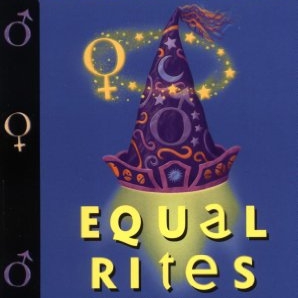
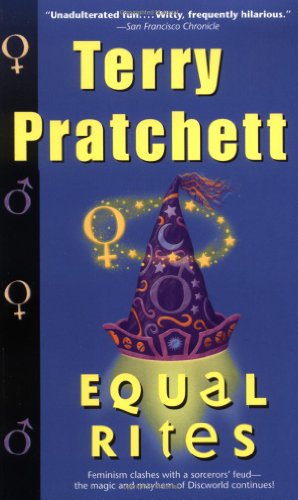
I’ve read Equal Rites before and I liked it well enough, but that was before I deluged myself with other fantastic fantasy literature over the years that set the bar higher. A reread of Equal Rites was very disappointing this time around. Maybe I’m expecting too much right now and my feelings are correct?
Here’s some stuff I liked about it:
– Granny Weatherwax
There was actually some cohesion this time around. While The Color of Magic and The Light Fantastic both seemed to be pieced together by a dozen different stories that just happened to star the same characters, Equal Rites actually had one story that lasted throughout the whole novel! Eskarina (Esk) is the eighth child of an eighth son. Usually these kids are wizards, but this eighth child happens to be a girl. And girls can’t be wizards! The dying wizard who passed on his staff as an inheritance didn’t know that until it was too late.
I liked the first half of the book because there was much more focus to it. We learn about Esk, the little girl who wants to do real magic. We learn about Granny Weatherwax, the witch whose magic mostly involves knowing what various herbs do. Granny tries to take Esk under her wing to learn witch magic, but Esk is extremely uninterested until she learns that Granny can “Borrow” animals by getting in their heads and controlling them. This causes Esk to bind herself with an eagle, almost not returning to her own body. See, this was all very interesting stuff! I liked this stuff! It was cool and entertaining and good.
The feminist themes were pretty forward-thinking for a man in 1987. The persistence of Esk trying to be accepted as a wizard in a field dominated by men — men who aren’t accepting women in their club because it’s “against the lore” — was some good ol’ hard-hitting social commentary! I like that the two strongest characters were Granny and Esk. I like the ineffectual and weak dispositions of the men. I thought Simon was a fun foil for Esk’s radical ideas. And, of course, in the end, Esk’s efforts prevail! She gets accepted as a wizard, and she and Simon collaborate to develop a new type of magic.
Here’s some stuff I didn’t like about it:
– Esk
This is possibly just a case of early-book-syndrome, but man are Pratchett’s ideas all over the place. Just like the first two books, Pratchett jumps head first into tangents and diversions that are bogged down with purple prose. It’s like trying to sift through an ADHD-addled mind. The narrative is constantly disrupted and convoluted, so much so that the 213 pages took me about a full week to get through. Nothing flows with enough grace to make it a page turner. It was a bit frustrating to weave my way though the dense thickets of the writing. It’s like trying to read my dumbass blog!
I really hope this gets better as the books progress into the good stuff. I love the idea of these books, but they’re a little bit of a nightmare to get through. I don’t want it all to be a slog! That would be sad.
BOOK BONFIRE DISCUSSION QUESTIONS!
Does Pratchett succeed in writing a “feminist” book? Does he seem to have set out to do so? Does he avoid the usual errors of male authors who use female protagonists?
Doesn’t Terry Pratchett set out to do everything? The name of his game is social commentary, ain’t it? The name of the fucking thing is “Equal Rites”. What kind of question is that?
I’m not sure if I’d say Pratchett succeeded in writing a feminist book, because I’m still ever-growing as a feminist myself and sometimes I still learn about all the pitfalls along the way. The theme of Equal Rites is gender equality, although some of the tropes and pitfalls are still present. Men become wizards, women become witches, and that how it has always been and forever shall be. Inherent in this idea are the gender roles. Different types of magic for each sex, and the wizards have an air of superiority over the witches due to their more “complex” magic, whatever that is. Esk breaks the gender barrier on wizardry, and spends much of the novel establishing herself as the wizard she is destined to be. While this is satire, and it attempts to spin the ideas of gender norms on its head, is it a feminist book?
– Esk
Most of the book passes the Bechdel test proficiently, with the two deliberately strongest characters being the persistent Esk and the hard-headed Granny Weatherwax. And although Granny spends her efforts trying to convince Esk of her destiny of “women’s work”, she grows as a character and pivots to spending her efforts getting Esk into Unseen University. Pratchett was able to give these two female characters distinct personalities that aren’t beholden by usual adventure story tropes, such as the damsel-in-distress. Can you imagine Granny a damsel in the first place, let alone in distress?? Preposterous!
So I’m going to say yes, I guess. But what do I know? I’m an insufferable white guy like Ross Gellar.
FINAL THOUGHTS
This is the first Discworld book with a steady story, but there’s still a lot of meandering and the story can be hard to follow. I think things fell apart near the end with the Dungeon Dimensions, but the first half was very good. And it’s a short book. It took me 890 days to read it, but you can probably bang it out in an afternoon because you’re smarter than I am.


Click here to ridicule this post!