
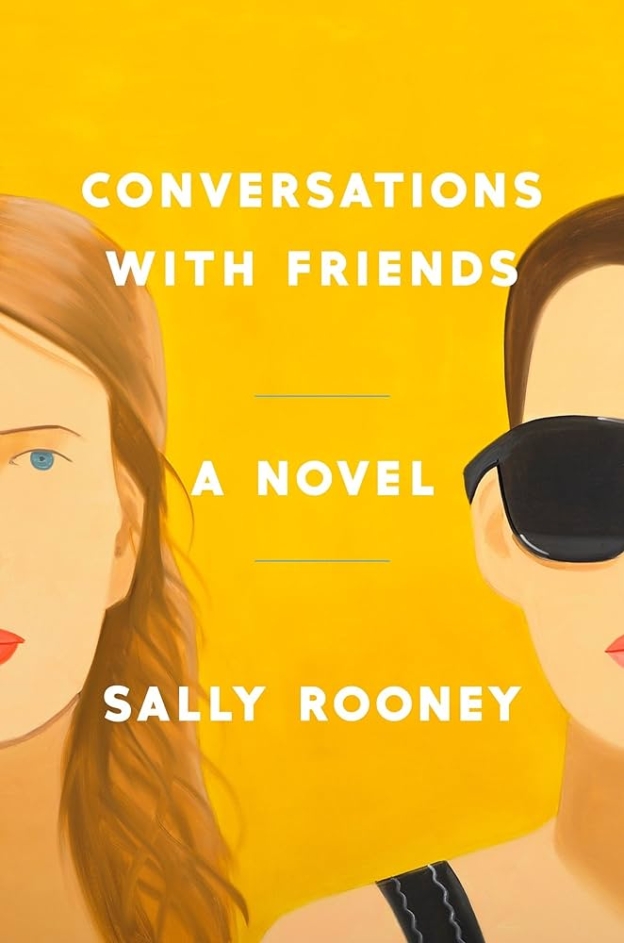
Welcome to the Book Bonfire where, today (unless you’re reading this 65 years from now when I’ll assuredly be dead, but I prepaid web hosting until the year 35,000) we’ll discuss a book I read because I liked Normal People (and the show) so much. Did Sally Rooney knock it out of the park with her first novel, Conversations with Friends, or does it suck so badly that just holding the book in your hands gives you cancer?? The answer may surprise you!
I’m starting to learn that Sally Rooney is an incredibly polarizing author, and I’ve boiled it down to the most essential reason: you either relate with the characters or you don’t. That’s it. If you don’t know what it’s like to be cripplingly anxious or depressed, then you will hate the characters, their motivations, their actions, their thoughts, their feelings, their appearances, their interpersonal relationships, their shoe sizes, and their ambitions. Rooney looks forlorn in almost every picture of her I’ve seen, so it’s no surprise that all her characters are deliberately flawed, neurotic, almost completely awful people. And perhaps “awful” is subjective. Many people think they’re awful and frustrating. I find them painfully realistic.
I didn’t love Conversations with Friends like I loved Normal People, but the story and themes are similar. The book plugs along through the point of view of Frances, a 21-year-old college student with, you guessed it, anxiety, depression, self-esteem, and self-worth issues. Her best friend and former partner Bobbi is described (through Frances’ eyes, mind you) as a completely perfect person. Gorgeous, confident, brilliant, and likeable. Nick is a 32-year-old, strikingly handsome actor who is deceptively insecure. Melissa is Nick’s pretentious wife in her late 30s. All four of these people are pretty insufferable, but I’m pretty insufferable so I find a lot to relate to here, unfortunately. What does that say about me? Don’t care!
– Frances
At first I was a little bit overwhelmed by Rooney’s writing style, which I was already very familiar with from Normal People i.e. no quotation marks to differentiate the dialogue and the overwhelming amount of figurative language and similes. Whereas Normal People plopped you right in the middle of a Connell/Marianne conversation that was awkward and uncomfortable anyway, Conversations with Friends plops you right into a poetry night with four people talking to one another. Four people talking without quotation marks before you even know who these people are. As Part 1 goes on, Frances and Nick slowly build a friendship and start an affair. While they hit it off, I didn’t find their chemistry particularly engaging in any way. I found Frances and Bobbi’s dynamic much more exciting, because those two actually did have vibrant chemistry and I found their conversations about topics such as the power dynamics of male/female relationships humorously and purposely glib. Melissa is a whole big bowl of nothing.
Part 2 is much better; there’s a lot more psychological trauma! Frances has fallen hopelessly emotionally dependent on Nick to the point where any lack of attention from him results in a series of cascading self-esteem episodes. He goes out of town for extended periods of time and Frances is numb and self-harms. She becomes such a mess that I’m surprised she doesn’t end up spiraling into a suicide attempt. I was honestly expecting it, but the worst she does is stab a hole in her thigh with scissors. We learn that Nick isn’t the confident hot shot actor that we think we know about him from the beginning. It turns out that he had major self-esteem issues and depressive episodes that led to psychiatric hospitalization. In short, Frances and Nick are perfect for each other! But they don’t end up together. Frances and Bobbi end up together, and that seems to be much more satisfying to me. Nick is a mess and he cheats on his wife. Frances is no better, though. She enables him.
– Bobbi
Forget about Melissa, she only exists one-dimensionally as a woman scorned. Bobbi at least has fleshed-out one-dimensionality, meaning that she’s just a beautiful, snobby, gay intellectual who reads books about socialism and likes to have arguments about capitalism. She’s also kind of rude.
That about covers it! Onto the insipid discussion questions.
BOOK BONFIRE DISCUSSION QUESTIONS!
Melissa suggests that Frances’ relationship with her own father affects how she views her relationship with Nick. In what ways do the characters’ parents shape their views on love?
As far as I can recall, Frances is the only one with parents in this story, is that not true? Like, Bobbi’s running around all willy-nilly quite free and parentless, that’s for sure.
– Nick
Frances has got some classic codependency shit going on. She craves attention and love from Nick, and when she can’t get it she breaks down and spirals. A lot of the second half of the book touches upon this, where she has these out-of-body experiences whenever she senses her relationship isn’t solid. One of my favorite scenes involves a strange call from Frances’ father, wherein it sounds like there’s something wrong but he won’t say it in words. He freaks Frances out, and then he abruptly hangs up. She describes a feeling of all the furniture floating to the ceiling and out of the room. I cracked up at this. I cracked up at Frances’ misery. Anyway, she and her father have this tense relationship where he needs her more than she needs him and this obviously causes Frances’ father some level of despair. Parallels.
In short, Frances’ relationship with Nick is unhealthy in more ways than, like, 20. And his inability to fully reciprocate feelings for her leads her down a rabbit hole of dark thoughts. Like the impending heat death of the universe. Like, total lmao there. I’ve done that many times.
Frances struggles with endometriosis and self-harm throughout the novel. How would you characterize her relationship with her body? In what ways does this affect her relationships with those around her?
There’s a scene where Frances stands naked in front of a mirror and dislikes what she sees. Body dysmorphia that was likely already there before all the Nick turmoil. Nick’s situation where he can’t (or won’t, as Frances worries) go all in on his and Frances’ relationship makes her feel like she is incapable of being loved, and therefore projects this onto her body issues to the point of hatred. To the point of stabbing a hole in her leg with scissors.
– Frances
The endometriosis leads to believe that her body is literally crapping out on her. Well… not literally crapping out on her. I meant literally in the figurative sense, of course. What’s the moral of the story? *I do the thing where I put clap emojis between every word* Don’t let anyone else be the source of your happiness because happiness comes from within!
I’m glad we finally learned something important in my blog, buried 1400 words down into a post no one will ever, ever read!
FINAL THOUGHTS
This wasn’t as good as Normal People since all the characters were far, far worse people and the main theme of infidelity is a little bit skeezy. It took me a good chunk of the book before I started getting into it, somewhere around 125 pages to be honest. If it weren’t for my tendency to suffer through a book until its end (a treatment which some books don’t even get), I would’ve bailed by then. I’m glad I didn’t, because the second half is far better. Your own mileage may vary.
Definitely liked it enough to check out the TV show, though.





Click here to ridicule this post!