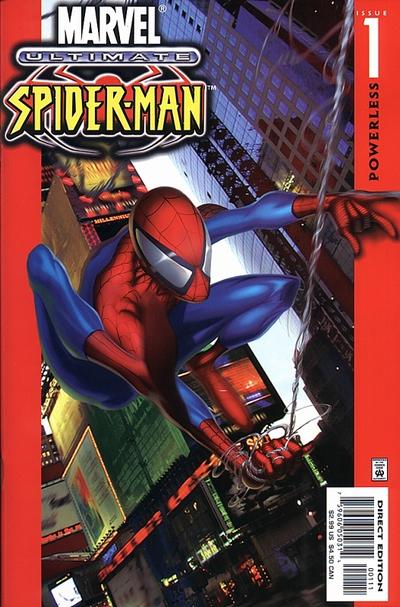
Ultimate Spider-Man (Vol. 1), Issue #1

Ultimate Spider-Man (Vol. 1), Issue #1 – “Powerless”

* Part 1 of 7 of the Power and Responsibility storyline *

Welcome to Loneliness & Cheeseburgers presents: Ultimate Spider-Man (Vol.1), Issue #1! If you’re reading this very post in realtime, OR you started chronologically, then congratulations on stumbling upon a brand new blog feature that’s not music-related. I’m finally putting the “stuff” into “Tom Writes About Stuff”!

EARLY DISCLAIMER: I know jackshit about comic books. You’re reading me getting into a brand new hobby at 33-years-old. Everything that’s objectively incorrect is because I’m learning as I go, and you, the unsuspecting reader, now have to deal with it.

In the year of our lord 2000, due to declining interest and sales in comic books, Marvel decided to reboot everything! And I mean EVERYTHING! The entire “Ultimate Universe” takes place completely separate of the mainstream Marvel universe and can be considered an isolated entity from nearly everything that came before it…and then nearly everything that came after it. In fact, they created Earth-1610 to contain all the stories in the “Ultimate” line of Marvel series. By 2015 they tied the Ultimate Universe back into the mainstream Universe and moved on forever.

We begin our Ultimate journey right at the beginning of Ultimate Spider-Man, which apparently starts at the very beginning and hits all of the major Spider-Man storylines over the course of its run. I’m excited! My hands are trembling with unbridled joy! I don’t know much about comic books, but I do know enough about Spider-Man to know that I’m looking forward to this journey. I’ll still be snarky, though. Buckle up, here we go.

If you have access to this comic book, feel free to read along with my shitty commentary and immerse yourself in the magic!


Ultimate Spider-Man (Vol. 1), Issue #1 [October, 2000]
Written by: Brian Michael Bendis
“Powerless”

Ultimate Spider-Man (Vol. 1), Issue #1

Did you know that Ralph Macchio is a comic book editor? But not that Ralph Macchio! A different Ralph Macchio! That’s crazy to me.

Hey, hello! Our adventure begins right at the beginning, where the beginning of all great adventures begin! We are treated to a peak into the lab at Osborn Industries, where Harry Osborn’s shitty dad is distracted by a phone call and one of his test subject spiders escapes a container. I WONDER WHAT IS GOING TO HAPPEN NEXT WITH THIS!

Cut to a mall food court, where our hero Mr. Harry-Potter-lookin’ science nerd Peter Parker is sitting alone like a nerd reading nerd chemistry books while every table around him is full of rowdy teenagers whoopin’ it up and harassing him by pelting him with food. Mary Jane, the redhead and not the marijuana wacky tabaccy cigarettes that the kids are into these days, is sympathetic to Parker’s plight.

We get a lot of pages of this abuse from Parker’s high school peers, and it seems that his only friend is Harry Osborn, a jock who only likes Parker because he does his homework for him. But since Parker is wimpy and useless and gets taken advantage of at every turn, he obviously takes what he can get and it ain’t much. It’s revealed during a scene alone with Harry that Peter’s parents died in a plane crash and that his dad was a scientist working on developing an adhesive. I WRITE THIS DOWN HERE BECAUSE IT SEEMS IMPORTANT FOR ME TO REMEMBER LATER.

Parker lives with his Aunt May and Uncle Ben (not the rice guy…unless that will be revealed later!), who are very supportive and a bit overbearing. At least Aunt May is overbearing, Uncle Ben (who looks kinda like Richard Gere with a goddamned ponytail) is less overbearing but still troubled and concerned by Peter’s bullying and antisocial behavior. They help as much as they can, as caring parental figures do, but since Peter is some snot-nosed 15-year-old twerp there’s not really much one can do, now is there?

It’s revealed in another scene that Harry’s dad is a shithead to him. Surprise surprise.

Ultimate Spider-Man (Vol. 1), Issue #1

Nerd!

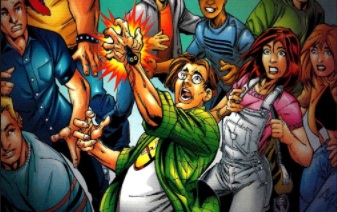
Now we get to the good stuff: Parker’s class is taking a field trip through Osborn’s lab AND THE FUCKING SPIDER BITES HIM! WHAT? HA! That’s funny! What a loser, the hallway is FULL of kids and it happens to bite the nerd that nobody likes! I would like to make a note of this particular occurrence, because it seems to me that this will become very important to the story later on! But what do I know? I can’t stop thinking about Tobey Maguire and Kirsten Dunst! After the spider gnaws on Parker for a bit, he collapses and the next thing he knows he’s on the school bus headed back. Meanwhile, Norman “Funny Bones” Osborne decides that he’s going to keep an eye on Parker for a while, because, you know, grown men love to keep their eyes on teenage boys? He sends his family a fruit basket and picks up the hospital tab.

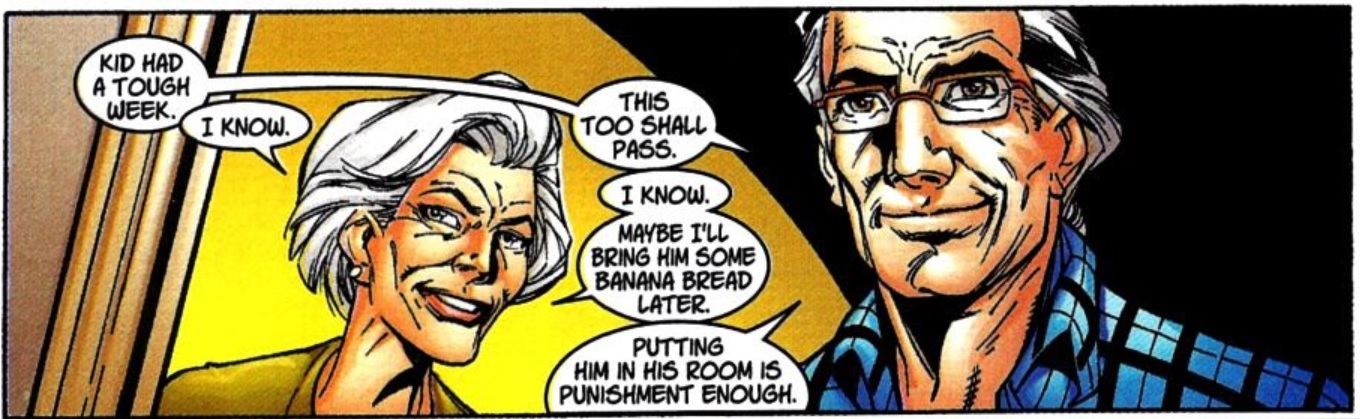
When Peter Parker, the teenager, finally comes home he heads upstairs to his teenage room and collapses from exhaustion on his teenage bed. Aunt May is concerned, but Uncle Ben basically tells her that he’s just a teenager. That’s what I said too! They discuss the fruit basket and the paid hospital bill, chalk it up to Osborne keeping good faith to avoid getting sued, and decide to move on with their lives. “No. No, it’s back to normal for us.” says Uncle Ben, stupidly. Come on, there are plenty of issues in this comic book series after this, Ben! Aren’t you aware? Or maybe you’ll be dead by, like, Issue #6?

Ultimate Spider-Man (Vol. 1), Issue #1

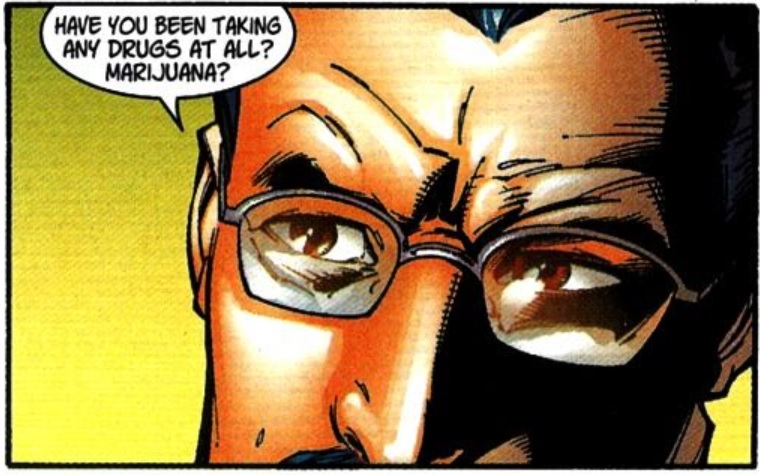
Looks like Dr. Furrowed Brow is looking for a new buddy to get high with!

The next day at school, Parker gets harassed, as usual, by the entire student body and maybe even the teachers too behind his back because he sucks so much. I mean, come on, just look at him. As Kong, one of Midtown High School’s more bald and corpulent bullies, attempts to boot Parker right in the butt, Parker senses this attack spidey-style and flips the motherfucker over right onto his back in the middle of the hallway. Needless to say, this draws a minor amount of attention. Shortly after, Parker has another weird, very public seizure in front of everyone and wakes up in the hospital. The doctor asks him with stern, piercing eyes “Have you been taking any drugs at all? Marijuana?“, and Parker says “Daaaaaaaamn, yo, the fuck is your problem?“. The nurse takes his blood and some Osborne Labs shadow guy literally steals it immediately in front of everyone without being noticed.

Back at Osborne Labs, the analysis of Peter Parker’s blood indicates that the kid is going to die. Fearing that the death of Parker due to the spider bite will be traced back to the lab, Osborne orders a motherfuckin’ assassination on the little punk. The next morning, Shadow Guy attempts to run him down with a car (the loudest and most visible form of assassination) but Parker’s spidey sense alerts him just in time to do a fantastic, majestic, flailing backflip over the car. When Shadow Guy pulls out a gun, Parker runs away. After calling back to Osborne to let him know that he fucking failed at killing a stupid kid, Osborne cancels the hit with the intention to study Parker further.

Parker has panicky fit in his bedroom about the changes that are happening to him. This angst carries over into his interactions with his Aunt and Uncle, who are awfully patient with this twerp and I would’ve smacked him around already with that back-sassin’, sexy mouth of his! Amidst all this, Peter does some super Year 2000 research of his own with respect to Osbrone Labs and spiders in general. We, the readers, are left with quite a cliffhanger of a panel where Peter Parker is hanging from the ceiling just like a spider! What!?! WHAAAAT?! AHHHH! BUH! FUHUBFUB!

Ultimate Spider-Man (Vol. 1), Issue #1

Side-splitting comic relief from Zsa Zsa Gabor and her ninth husband.

Final Thoughts

I know this part of the story already! But, hey, since this is Earth-1610 and that’s technically an alternate reality separate from the main Marvel Earth-616 anything could happen, right? This shit is canon but it’s not! I don’t know! The Marvel multiverse has a trillion alternate realities, how the hell am I ever going to know anything about anything?

Anyway, reading comics and writing about them are going to be a nice way to waste the rest of my life. Stay tuned! Much, much, much, much, much, much, much, more is coming. And yes, that’s a threat!

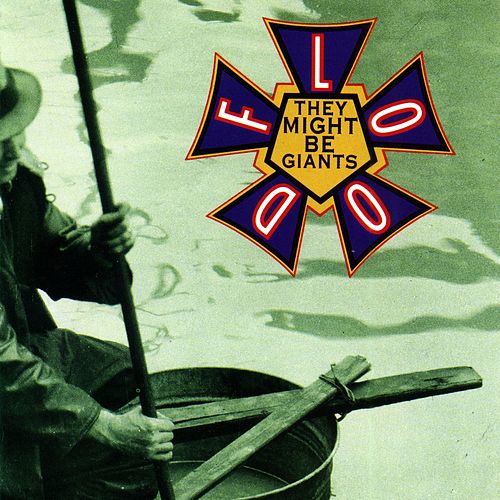
They Might Be Giants – Flood (1990)

They Might Be Giants - Flood

It’s a brand new record for 1990/They Might Be Giants’ brand new album Flood” – “Theme From Flood” from They Might Be Giants’ 1990 album Flood, the best third album named Flood from a band until the experimental Japanese band Boris puts out their third album Flood in 2000!

Flood flood flood flood flood. The word has lost all meaning now. That’s called “semantic satiation”, friends, but I’m not here to talk about semantic satiation! I’m here to talk about Flood! Yes, that’s right, a flood of sperm! That’s called “semen-tic satiation”, friends, but I’m not here to-

TMBG’s third studio album is their first on a major label, which means better production, better equipment, and better marketing. The Johns’ promotion of Flood was their most successful, and by a long shot it’s their most well-known album to date. They were approached by Warner Bros. to make music videos out of “Istanbul (Not Constantinople)” and “Particle Man” for Tiny Toon Adventures, and the Johns credit a lot of Flood’s mainstream success to this exposure to a young audience. Admittedly, fuckin’ Tiny Toons is why I know about They Might Be Giants, and Flood was the first album by a real band that I ever bought with my own money! “Weird Al” doesn’t count.

Fancy schmancy major label perks aside, this record isn’t a significant deviation away from their established formula of stylistic diversity and humorous wordplay. It’s not nearly as weird, though. I mean, it’s still weird, but it’s not even close to what we’ve had before. The Johns took special care for their Elektra debut to not alienate a new audience with too much oddball silliness in order to avoid being stamped as a novelty act. Did it work? Well, two songs were on Tiny Toons so I don’t know for sure. All I know is, it’s plenty silly anyway, people really like this album, and the band’s legacy lives on. In a nutshell, who cares?

There are pros and cons to reigning in the weird a little bit. Mainstream approaches to songwriting means more pressure is actually put on the songwriting itself to carry the burden of hooking the listener, since weirdness can be an easy copout hook strategy. The good news for them is that they’ve already successfully done some of these kinds of songs before. Think “She’s an Angel” off the debut, or “They’ll Need a Crane” off of Lincoln. There’s just more of it here this time. I think songs like “Birdhouse in Your Soul”, “Twisting”, and “I Want a Rock” are examples of amazing mainstream songwriting, and indeed most of the front half of Flood showcases these types of songs. The back half is reserved for the weirder stuff, and on this album I think it’s all way weaker than anything on the front half. Flood is TMBG’s most front-loaded album in their catalog by far.

So let me start by singing the front half’s praises. But before I start singing the front half’s praises, how about I instead sing the faults! I personally dislike “Dead”, a slow-moving shuffle that relies more on its wordplay than its melody, and the pseudo-calypso “Your Racist Friend” seems like an uncharacteristically literal sociopolitical take for a They Might Be Giants song. Although, there are some great guitar riffs and some nice horn parts during the instrumental bridge, so it’s not all racism and friendship here.

With that out of the way, the rest of the front half is great to excellent, with the aforementioned “Birdhouse in Your Soul” being the band’s HIGHEST. CHARTING. SINGLE. EVER. At #3 on the US Alternative Airplay chart. But, hey, recognition is recognition! And it’s a jaunty song, too! It’s about a nightlight shaped like a bluebird, and John Linnell wastes no lyric making this clear in riddle fashion (“My name is blue canary/One note spelled L-I-T-E” is just one of many). “Lucky Ball & Chain” is another jubilantly depressive Flansburgh classic about divorce and/or heartache, with most of the song bouncy except for the short, dissonant minor-key bridge that betrays a real sense of inner turmoil (and it’s the best part of the song, even if only lasts about four measures). “Istanbul (Not Constantinople)” is a fantastic reworking of some ’50s novelty song that was written 500 years after the fall of Constantinople, and it has some great fuckin’ trumpet bits and snake-y Eastern violin keeping the song exciting all the way through. For a bonus, check out the live version on TMBG’s Severe Tire Damage concert album, which has one of the most astonishingly beautiful trumpet solos I’ve ever heard on a live rock track. The one-two-three pop earworm punch of “Particle Man”, “Twisting”, and “We Want a Rock” will stick in your head for years, guaranteed. Also, if you’re like me, then for most of your early/mid teenage years you were exposed to new bands based solely upon them being namedropped in other bands’ songs, so then you also checked out the dB’s and the Young Fresh Fellows since they were both mentioned in “Twisting”. And then you liked them. Hint hint.

Side Two is weaker, but after giving this album another listen I think it’s really only because Side One is so damn strong that it’s a hard act to follow. A couple of these tracks are perfectly catchy, but they lack real character, like “Hot Cha” (a song barely based on one of the racehorses from an old Parker Brothers game about the Kentucky Derby) and “Women & Men” (a cheerful sea shanty about the proliferation of the human race). More likely, they’re so short that there isn’t much room to flesh them out. “Minimum Wage” is a total throwaway where Flansburgh yelps “MINIMUM WAAAAAAAGE! YEEHAW!” with a Rawhide whipcrack. Dumb! Others, like “Letterbox”, “They Might Be Giants”, “Road Movie to Berlin”, they’re all fine at best. I just can’t get too excited about any of it, it almost feels like Side Two is a different album altogether. Although I do like the glistening synth droplets all over “Sapphire Bullets of Pure Love”, and the military march of “Whistling in the Dark”. Both of these tracks should trade places with Side One’s “Dead” and “Your Racist Friend”.

Oh man, and “Hearing Aid” I really hated that the first 45 times I heard it; a lo-fi, noisy swing number with about a minute of useless industrial noise at the end. I’ve come to really appreciate it because, like everything else, it’s too smart for its own good. Bad production because the song’s narrator can barely hear anyway, he turns off his hearing aid so that he doesn’t have to listen to his boss berating him (“For king-lazybones like myself” can be easily interpreted as “fucking lazy bums like myself” to someone who didn’t hear it very well), and then the final minute of clicking and whirring is possibly the internal head-noise of the guy with the hearing aid turned off. I’ve come around on it completely. So at least there’s that!

A lopsided album, but the positives far outweigh the negatives, and early TMBG is always a great option anyway EVEN IF THEY SOLD OUT TO A MAJOR LABEL. Ha! What a fake fucking complaint about any band!

GOOD

This Heat


This Heat was a short-lived band tangentially involved with the British punk/post-punk scene of the late ’70s. Comprising of multi-instrumentalist Charles Bullen, multi-instrumentalist Charles Hayward, and non-musically trained at all whatsoever but played some instruments anyway visual artist Gareth Williams, the group combined elements of their varied backgrounds to create what MUSIC HISTORIANS would later describe as the “missing link between progressive rock and post-punk”.

Although they were not the very first to do this kind of thing (Throbbing Gristle, for example, was active for about a year before This Heat started working on recording their debut), This Heat coalesced their disparate influences into something incredibly succinct and musically meaningful in ways that weren’t achieved by the likes of Throbbling Gristle and similar contemporary progenitors. While early industrial music projects sought to flip the idea of “music” on its head and present something purposefully transgressive, bastardized, and inaccessible, This Heat brings something…well, equally transgressive, bastardized, and inaccessible, but with sincerity! There’s the difference, I think. Plus, like accidental prophets, This Heat predicted the path of art-rock, post-punk, post-rock, noise rock, indie rock, industrial rock, experimental music, ambient music, electronica, and progressive rock. Succinctly. Ah, but was the band actually ahead of its time, or was This Heat just so influential and in the right place at the right time that they set the course themselves? That’s the real question.

As for the “missing link between progressive rock and post-punk” bit, I agree and disagree with that one. Agree, because This Heat’s music is truly neither progressive rock NOR post-punk, and I guess if there was a missing link to fill single-handedly by one outfit like This Heat, then there you have it I suppose. Disagree, because much, much, much of post-punk takes its lead from krautrock, and if anything it’s krautrock that’s the missing link here since krautrock is a cousin of progressive rock in the first place. This Heat owes a lot of their debt to Can, Faust, Kraftwerk, maybe some Amon Düül, and, again, to say they were the first to channel it into the experimental proto-post-punk context is still not true. That’s where we need to be discussing Throbbing Gristle, Cabaret Voltaire, even Karlheinz Stockhausen. However, the band did all their recordings in a repurposed meat locker, so perhaps they were more progressive than I give them credit for.

And there you have it. The band called it quits after releasing their second album due to artistic differences (inevitable with three very strong artistic personalities). Williams died of cancer in 2001, but Bullen and Heyward reunited to perform music under the name This Is Not This Heat between 2016-2019.

This Heat’s Bandcamp page

JUMP TO:
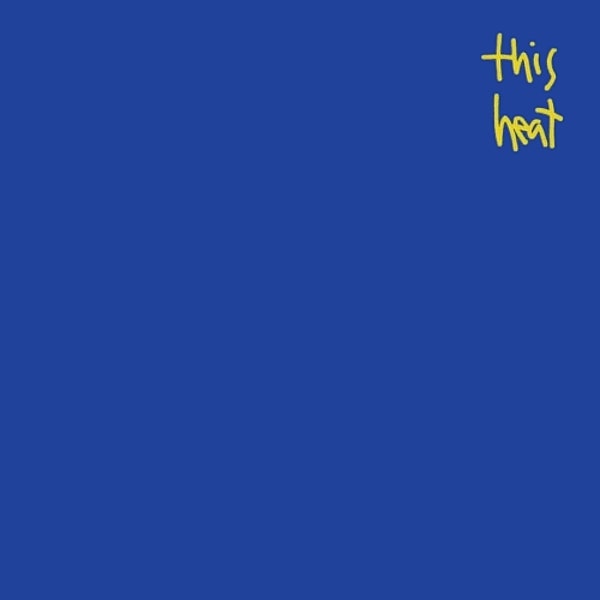
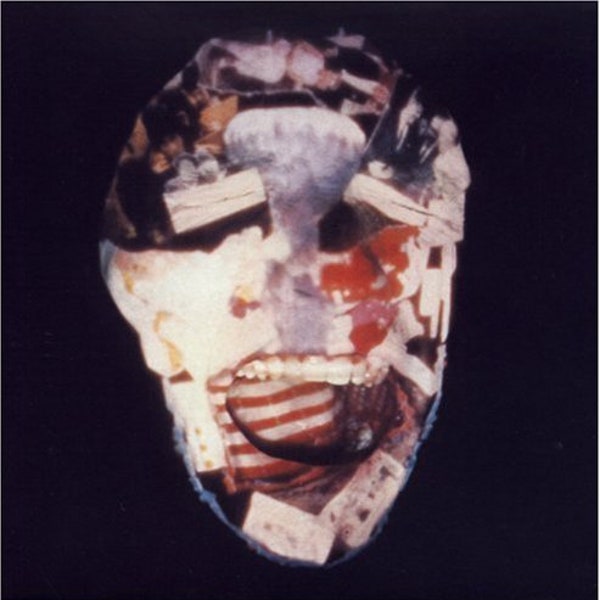
(1979) This Heat
(1981) Deceit


This Heat (1979) – Rating: 7/10
No Full Album Review Yet

This Heat - This Heat

Blaming heavy metal music as a recruitment tool for fake cults during the Satanic Panic of the ’80s is especially funny, considering albums like This Heat’s self-titled debut from 1979 is way scarier than anything any heavy metal band could ever come up with. Recorded over the span of about two years, the band experimented with tape loops, microphone placement, vocal modulation, and tape manipulation. The humble beginnings of this album’s recording sessions predate post-punk entirely, but to call This Heat a post-punk record is a misnomer. This is an industrial record.

On an intellectual level, this music is really something. All the careful planning, sequencing, and recording techniques have resulted in a transcendentally eerie product. For people like me born in the late ’80s who have nothing more than a hazy memory of the pre-Soviet collapse, music like this is the closest thing I have as the strange, unsettling soundtrack to the Cold War era. The group creates tension using unassuming, low-volume passages and then releases that tension with occasional sudden bursts of noisy aggression. The lo-fi recordings add an extra layer of foreboding dread, like the band was holed up in a bunker and This Heat is their black box-type final recording.

As such, I think This Heat would be a much more powerful album if it were the band’s only album (but, ironically, the band would likely have faded to obscurity if this was their only output). The project on an intellectual level bumps the rating up a few points, but on a pure enjoyment level this is a challenging listen. The two “Testcard” bookend tracks are just the same low-volume drone of white noise; the first “Testcard” tricks the listener into turning up the volume so they be blasted with loudness at the top of “Horizontal Hold”, which is a raw combination of  sharp drum patterns and abrasive electronic interstitials. Tracks like the slow and static “Not Waving”, or the delicate pots-and-pans percussion of “Water”, or the creepy muffled lyrical poem of “Music Like Escaping Gas”, these all feel like a collection of pieces that don’t unify fully into a singular artistic statement. In fact, the first real genuine instance where I even really perk up during a listen of This Heat happens on Track 6, the accessible “24 Track Loop” with its steady techno beat and bizarre Atari-era electronic noises.

While the cold, curiously foreign feel that this record demonstrates from beginning to end is intriguing, I find it difficult to get too worked up about any of this. I love my experimental and industrial noise projects, don’t get me wrong, but I have a feeling the bulk of the real influence This Heat had on future musicians came from their second album.


Deceit (1981) – Rating: 9/10
No Full Album Review Yet

This Heat - Deceit

Yes, now we’re talking! Deceit, the second and final studio long play, takes the avantgarde sonic landscapes of This Heat and works it into a more appealing, loosely song-oriented enterprise. Deceit‘s existence is equally as important for the band as This Heat in shaping their legacy, because a) it shows they didn’t try to do the same thing twice, b) they were able to prove that they could innovate within their own constraints, and c) they provided a second, completely different angle to channel that same nuclear war anxiety that the debut was also working to deliver. If this album didn’t come out, really no one would have cared about this group at all. Period.

Throughout Deceit we hear more lyrics than before, which means more overt political statements. They’re employing the same haunted, lo-fi abandoned meat-locker production as they did on This Heat, continuing to add a layer of hopeless tension to these otherwise cheerful tunes! We start with “Sleep”, which is unlike anything we’ve actually heard before from This Heat. It’s a creepy, desperate lullaby urging the listener that one can always just sleep to escape “We never forget you have a choice/Possibilities in store, a taste of paradise/Success on a plate for you, endless promises“. “S.P.Q.R.” is a banger reminiscent of contemporary post-punk acts like Wire or The Pop Group, based on ancient Roman politics and the current-day satirical translation of “S.P.Q.R.” (“We Are All Romans!”). “Cenotaph” uses completely atonal and unnerving tritone scales or something, with Williams’ anguished “History repeats itseelllllllf“. There’s so much sociopolitical history going on in all these sentiments, and I’m really fucking dumb about any kind of history, so much of this is completely lost on me on a lyrical level. BUT, oh man, it sounds vital to me anyway! That’s how you know it’s powerful.

The record ends with the instrumental “Hi Baku Shyo (Suffer Bomb Disease)”, which leaves the listener with an audio illustration representing dropped bombs in Japan during WWII.

As statements of harrowing geopolitical unrest, the debut beats out Deceit marginally by painting a scarier musical picture, but Deceit is by far the more satisfying lasting impression.


Maybe some day I’ll also review their 1980 EP Health and Efficiency, which displays the transition between the This Heat sound collages and the Deceit song compositions! It’s a good EP for sure, but I’m not an EP-reviewing-kinda-guy! Listen to that too though. 8/10.

MUSH, Divide and Dissolve, and Django Django

This week I have new releases from MUSH, Divide and Dissolve, and Django Django! They’re not new, though, they’re basically six months old! But, hey, time is a circle. So shove it.


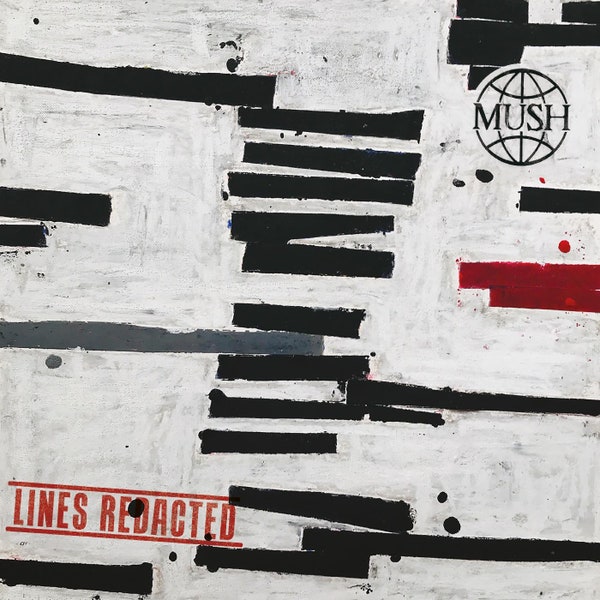
MUSH – Lines Redacted
(February 12, 2021)

MUSH - Lines Redacted

Reportedly, MUSH’s influences include Patti Smith, Richard Hell, Stephen Malkmus, the Fall, Stereolab, British Sea Power, and many others, and not once in any interview that I’ve seen have they mentioned Devo. And this is ridiculously nuts, because vocalist Dan Hyndman is doing the most blatant Mark Mothersbaugh impression that I’ve ever heard on every single one of these twelve tracks. I was floored when I learned that these guys were from Leeds instead the Midwestern United States. Just on the floor and beside myself, out of my body, shaking and purple and crying with disbelief.

I was very disappointed by Lines Redacted. The in-the-moment socio-political commentary feels manufactured and soulless, and maybe the flat and unenergetic riffs don’t help. Maybe it’s that Devo voice everywhere, this music sounds forced and uninspired. Unless you count Trump’s remark last year about injecting bleach to kill the virus as inspiration for “Drink the Bleach”, or unless you count Russian election meddling as inspiration for “Bots!” It’s less “inspiration” and more “news items shoved in our faces for months and/or years”. I don’t know, this feels like the album equivalent of a social media newsfeed where randos can chime in with their opinions and then it’s forever lost in the muck of newer news. This album is so lethargically immediate that the lasting power wears away before the record even ends.

Sorry, MUSH. In a year with incredible British art punk albums by Dry Cleaning, Squid, black midi, Black Country, New Road, Sleaford Mods, and Snapped Ankles, the bar is already pretty high.

Early Verdict:


Divide and Dissolve – Gas Lit
(January 29, 2021)

Divide and Dissolve - Gas Lit

What instantly drew me to Divide and Dissolve was not that it’s merely a sludge/drone project, but it’s a sludge/drone by two women who aren’t even fans of sludge/drone. And not only that, but one woman is black and Cherokee, and one woman is Māori (indigenous New Zealanders via Polynesia). And not only that, but a lot of their band photos either show them wearing “Destroy White Supremacy” shirts or, like, Edwardian era dresses or something (maybe, I’m not a goddamn fashion historian!). Combine all of these elements for a truly unique perspective.

Now, to me, the “not even fans of sludge/drone” aspect shows that the message that Takiaya Reed and Sylvie Nehill wish to convey is more important, to them, than the music itself. I was conflicted by this at first because, as a music fan of music, the music comes first. Turns out they’re pretty good at making music they barely like, so who gives a shit in the end? Gas Lit is the duo’s third album of heavy, oppressive walls of sound punctuated by impossibly lush beauty. It makes the drone less dark and drone-y when you add in Reed’s melodious saxophone over Nehill knocking her drumkit around the fucking room. And, surprise, it really leaves an impression! Just like music is supposed to do!

For a project that’s rooted in social commentary and political awareness, it’s curious that only one track “Did You Have Something To Do With It” has any words at all, but it’s a powerful piece of spoken-word poetry delivered by painter/writer Minori Sanchiz-Fung with calculated emotionless objectivity. “This was the blow which we struck/At first without knowing how deep it would grow/It would grow into a frightening history that fractures hope“. Bleak stuff! I’m grinning ear-to-ear!

This genre is dominated by beardy white dudes with try-hard tattoos, so I’m glad that some non-white women are using it for feminist reasons. And guess what, they’re making music that’s more interesting and raw than 95% of the beardy white dudes with try-hard tattoos! And guess what, they’re NOT EVEN FANS of this music! Take that, you beardy fucking losers!

Early Verdict:


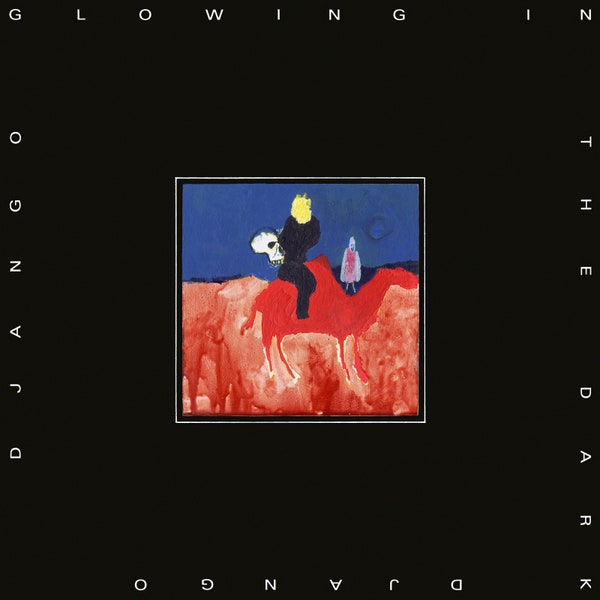
Django Django – Glowing in the Dark
(February 12, 2021)

Django Django - Glowing in the Dark

I really liked Django Django’s self-titled debut from 2013, and then for eight more years I never listened to another thing they did! They’re often described as a psychedelic pop band even though I don’t find them particularly “psychedelic” per se, at least not in the same lo-fi garage-rock way that any ’60s psychedelic band or a King Gizz or an early Tame Impala might be. Perhaps they’re “psychedelic” in the less-celebrated mood-painting sense instead. Maybe the psychedelia actually worked for me, because I always thought his band was from Australia and, hence, their music sounds like a dreamy Australian wasteland in the same way the Nick Cave’s original band the Birthday Party doesn’t sound like a dreamy Australian wasteland! Maybe I also got Midnight Oil vibes from their smooth and pastoral synthy goodness? What’s my point again? Oh yeah, these guys are from London and I’m a dummy.

I was expecting next to nothing when I threw Glowing in the Dark on for a listen, mostly because Django Django seems to be one of those bands that burns quickly and fades away unceremoniously with each new release. This one was no exception. But, as the tracks kept coming, I was astonished by just how tight and catchy every song here was. And the music is peppered throughout with cool, unpredictable surprise hooks. I really like the “Safety Dance”-esque synth noodling during “Free From Gravity”, and the Egyptian minor scales in “Night of the Buffalo” (which also has a beautiful orchestral outro), and the thumping new wave basslines on the opener “Spirals”, and the Charlotte Gainsbourg vocals on “Waking Up” (which also has some Gene Ween “Roses Are Free” Prince-like vocals from Vincent Neff), and shit, I like all of it. I really do! What an underrated release.

I’m definitely going to need to listen to the two albums they released between this and their debut and catch up. You should too.

Early Verdict:

Frank Zappa – Waka/Jawaka (1972)

Frank Zappa - Waka/Jawaka
December of 1971 was extremely eventful for the Mothers of Invention. First, during a show in France, some dickhead in the audience fired a flare gun that burned down the casino. As everyone knows, this incident was immortalized in Deep Purple’s “Smoke on the Water”. The band lost $50,000 (equivalent to $320,000 today) worth of equipment and had to rent equipment for the rest of the tour, which wouldn’t last much longer anyway BECAUSE, secondly, a week later, Frank himself was attacked and knocked off stage by a member of the audience in London. He landed in the orchestra pit, which severely injured his head, neck, back, and one of his legs. This was the best thing to ever happen to Frank Zappa!

I mean, no, not really. He was wheelchair-bound for almost a year, suffered permanent back pain for the rest of his life, and a crushed larynx that changed his voice. He couldn’t tour during recovery, and THAT’S the good part, because it meant bye-bye Flo & Eddie! They didn’t want to wait for a recovery that may never happen, so they scooped up some Mothers members and went off on their own to continue their wildly unsuccessful frontman careers. Meanwhile, not content to sit around doing nothing, Zappa put his brain to some paper and started composing some jazz fusion music reminiscent of the immediate pre-Flo & Eddie era. In my mind, he picked up where he left off. After jotting down some freshly composed music, he assembled a team of session musicians (and some of the old Mothers alumni) and put together his own big band combo. Waka/Jawaka is the spiritual second installment of the trinity of jazz fusion records that are often lumped together in discussions about Zappa’s foray into jazz fusioning; the first being Hot Rats, the second being The Grand Wazoo. I like this one the best.

Four tracks total, 36 minutes. “Big Swifty” is the album’s 17-minute grand entrance; a jaw-dropping display of hyper-fast technical noodlings, layered instrumentation, and complex, professional, and mature compositional flexing. In fact, you could say the same about the title track “Waka/Jawaka”, which is the album’s 11-minute grand exit! Both tracks feature some of the most impossibly intricate and demanding jazz fusion outside of Miles Davis’ electric period, but Frank didn’t load up these arrangements with atonal, nonsensically avant-garde filler either. The album is at its most experimental during the more spacey sections of “Big Swifty”, but it never feels like the music completely disappears among trippy sludge like your average Sun Ra record. Anyone going into Waka/Jawaka with hesitations over the immense track lengths, worried about expansive John Zorn freak-outs or even, godforbid, Chick Corea or Pat Methany elevator muzak, they will be pleasantly surprised to find none of that here. After the opening theme and about a minute of tasteful full-band improvisation, “Big Swifty” features George Duke soloing on keyboard, then Sal Marquez soloing on trumpet, then Zappa himself improvising with guitar while Duke and Marquez continue noodling in the background. All these instruments lazily swirl around each other, creating moody and suspenseful atmosphere. I think the 17 minutes go by fast, but I also hit my head on concrete about 250 times as a child.

Gotta get back to the title track for a few comments. That bombastic staccato brass intro, followed by that raw, yet smooth and fluttery, trumpet solo over slightly exotic acoustic guitar accompaniment, followed by the dreamy and hazy Moog synthesizer solo? *chef’s kiss* Exquisite. Absolutely phenomenal. If anyone knows anything out there among early-’70s jazz fusion that hits the mark like the first five minutes of “Waka/Jawaka” please let me know, because I need more of this in my life. The next few minutes of Zappa’s guitar soloing, just like any other Zappa guitar solo, is excellent. After a brief drum solo, we come to a closing reprise that hits the major melodies introduced at the beginning of the piece, although slower. Fade to black. Fantastic.

The middle two tracks are vocal pieces with inoffensive lengths. “Your Mouth” is blues rock gone delightfully, horribly awry, with odd swaggering vocals and some cool horn parts. It feels like a demented alternate-universe Chunga’s Revenge cut (“Your mouth/Is your religion/You put your face in a hole like that“). “It Just Might Be a One-Shot Deal” fuses jazz with country-western music in an inconceivably perfect combination, ending with a blissful pedal steel guitar solo that could have been 45 minutes longer and I would have been on board for every single second. Any Zappa skeptic should at least hear this one, it’s one of the greatest underrated achievements of Zappa’s oeuvre and it’s buried here forever on one of his jazz fusion albums. As far as I’m aware, the track was never performed live in its entirety. Usually parts get chopped up for the “Greggery Peccary” suite, most notably the “You should be digging it while it’s happening” jump before the solo.

I think this whole album is a masterpiece. The immediate follow-up The Grand Wazoo does not hit any of the same ultra-highs for me despite its wider range of styles and motifs. Thank fucking God that Zappa was nearly crippled or else we would’ve had 100 more Flo & Eddie albums to sift through instead. I can’t even imagine that, it’s too painful.

VERY GOOD