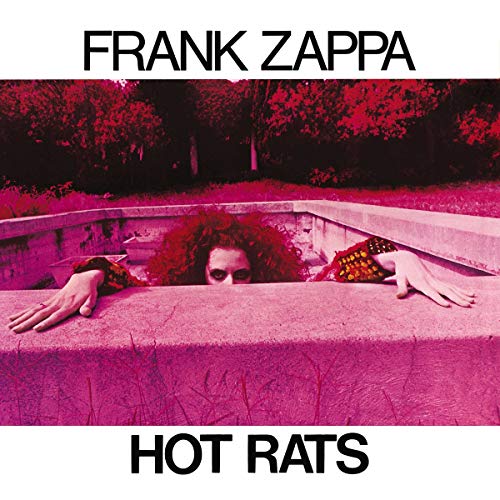
Review: Frank Zappa – Hot Rats (1969)


Here comes my first major challenge as a self-professed reviewer on the World Wide Web of musical albums that NO ONE READS except for YOU, and only because someone bumped your arm while you were trying to click the \”Fat Granny Fucks a Shoehorn\” link that your uncle posted on Facebook and clicked a link to my blog instead. Somehow. Anyway, this will be a challenge because 95% of Frank Zappa\’s Hot Rats is instrumental. I will actually need to talk about the music instead of falling back on my old hat weaselly writing tricks, such as incorrectly talking about what I think the meaning behind the meaningless words are, or making attention-diverting shoehorn-fucking jokes.

The previous album Uncle Meat may have marked a musical departure, but Hot Rats is a complete overhaul altogether. Zappa disbanded the Mothers of Invention entirely prior to the recording of this album due primarily to financial hardships and due secondarily to Zappa\’s dissatisfaction with the band\’s efforts (no one\’s gonna pretend he wasn\’t impossible to please). Of course, the Mothers were upset at Zappa\’s lack of compassion during these trying times, but it allowed him to recruit guest musicians without political interference. The only other member of the Mothers involved in Hot Rats was good ol\’ boy Ian Underwood, possibly because he knew how to play 45 instruments and was therefore a cheap keep.

Hot Rats is a pioneering record in the genre of jazz-rock, which was burgeoning at the end of late \’60s with rock bands like Cream experimenting with the incorporation of jazz elements and, conversely, jazz artists like Miles Davis experimenting with the incorporation of rock elements. Obviously, Zappa wasn\’t content with just melding the two genres; Hot Rats exhibits a lot of classical elements in the mix as well, especially in the shorter songs like \”Peaches En Regalia\”, the quintessential signature track of his whole career.

\”Peaches En Regalia\” is the track that everyone fucking knows, it\’s the track that casual fans will claim as their all-time favorite. I wonder if knowing this information in advance has soured my perception of \”Peaches En Regalia\” (which, as a 17-year-old, was an extremely likely by-product of my learning that something was critically acclaimed), but I\’m going to make a bold statement now, as a snotty 29-year-old, that this song…just…isn\’t…uh, let\’s just say that it doesn\’t do much for me. I\’m going to be honest here, in my gut I\’ve always felt like \”Peaches En Regalia\” really hasn\’t aged well. I\’ll give credit where credit is due here, it\’s a beautiful mid-tempo melody, simple and straightforward with a conventional song structure and without terribly complex rhythms. Your grandmother would even like it. The instrumental selection is your usual Zappa fare as well: plinky keyboards, flutes-a-flutter, brassy winds. And clocking in at about three and a half minutes, even the length is incredibly inoffensive. But my problem with it is that with all these elements together, at least give me some snarky or cynical lyrics or some slight minor key dissonance. This song is too fucking jubilant, it sounds like something out of Sesame Street. I never really understood the hype surrounding it. But don\’t worry about what I say, you\’re going to think it\’s fine.

Now the next track, \”Willie the Pimp\”, this is where I feel the record truly kicks off. This is the only track on Hot Rats with any lyrics, featuring the smooth, syrupy, cherubic vocals of one Mr. Captain Beefheart, Zappa\’s high school pal who was already an accomplished solo artist in his own right by 1969. I\’m being sarcastic about his voice of course, the man swallowed a porcupine. Say what you will about his mucus-ball utterances, it adds an extra level of skeeziness to a track already titled \”Willie the Pimp\” (\”I\’m a little pimp with my hair gassed back/Pair of khaki pants with my shoes shined black\”). The vocals are over after a couple minutes, the rest of the 9-minute track is a searing, dirty blues-based guitar jam that\’s up there with the most melodious extended solos in Zappa\’s catalog. A lot of criticism gets thrown toward Zappa\’s solos because they\’re typically meandering and perceived as superfluous, but \”Willie the Pimp\” is so impressively chock full of good musical ideas that I think it should supersede \”Peaches En Regalia\” as Zappa\’s signature tune. It\’s a jam so good you\’ll shit your pants on purpose!

Next up is another 9-minute jam session, \”Son of Mr. Green Genes\” (the title begot the rumor that Frank Zappa was the son of the guy who played Mr. Green Jeans on Captain Kangaroo, but if you look up the guy you can plainly see that, clearly, Ken Jennings of Jeopardy! fame is his real bastard son). FINALLY, after a quarter of the album\’s duration has elapsed, we get something that can actually be called jazz-fusion! The backbone of the track borrows the melody from \”Mr. Green Genes\” off of the Uncle Meat album, speeds it up a bit and expands the fuck out of it with bombastic horns and guitar solos. Not nearly as memorable as \”Willie the Pimp\”, but enjoyable while it\’s happening for sure.

\”Little Umbrellas\” is another tightly composed, short piece that I guess falls into the jazz-fusion category as long as you\’re fusing jazz with MY ASSHOLE, but I feel that this one brings the energy down a bit after the ~20-minute unrelenting endurance race of the previous two tracks. I suppose on the original LP this would be the beginning of Side B, which I could understand working better in such a context, but here in God\’s 21st century I\’m listening to the CD version, and I ain\’t like the flow. I just get antsy about the next song the whole time, which I\’ll talk about now. Fuck \”Little Umbrellas\”!

\”The Gumbo Variations\” is the most daunting track, clocking in at almost exactly 17-minutes. It\’s hard to tell whether or not \”Willie the Pimp\” and \”Son of Mr. Green Genes\” contain some improvisational elements due to their seemingly tight structures, but with \”The Gumbo Variations\” it\’s pretty clear that this studio jam session is all freeform and off-the-cuff. It starts off with a simple, funky bassline, joined in shortly by good ol\’ boy Ian Underwood stealing the spotlight for about 7 minutes on a kick-ass saxophone solo that bounces seamlessly between hook-laden musicality and squealing, aggressive free jazz. Next, as Underwood slowly backs out, Don \”Sugarcane\” \”Twinkletoes\” \”Voldemort\” Harris swoops in with some rectum-blistering electric violin action and keeps the jam going! And then sometime between Minute 10 and 45, I don\’t remember where because it blends in pretty nicely, Harris backs out and Zappa rides out the rest of the jam on guitar. Exhilarating! Unrelenting! This is probably my favorite track up to this point in the catalog, although \”Invocation & Ritual Dance of the Young Pumpkin\” off of Absolutely Free is a close second. Both are great examples of multiple musicians competently improvising and playing off each other as a cohesive unit for an extended session, and you don\’t get much of that in the early Zappa records. IT\’S NICE TO HAVE.

Hot Rats closes with another short(er), jazzy number \”It Must Be a Camel\” that, again, feels largely tacked on and forgettable. I have, in fact, listened to Hot Rats in its entirety about 70 times in my life and I couldn\’t even tell you what \”It Must Be a Camel\” sounds like right now (possibly because I now have Emperor\’s Anthems to the Welkin at Dusk cascading and rollicking through my ears at the moment like some sort of poseur).

As you have likely gleaned from this pedestrian album review, I find the shorter compositions very much inessential to the Hot Rats experience. The three long tracks are the real stars here (and \”Peaches En Regalia too, I suppose; you won\’t find very many people who would agree with my feelings about that one), so luckily they make up most of the album proper. As a result, I can say with a strong conviction that this isn\’t a perfect record at all, but most people who dive head first into Zappa\’s world tend to pick this album as one of their starting points (it was my second Zappa album purchase after Over-Nite Sensation), and if nothing else it will completely quash any preconceived notions that Zappa is merely a \”Weird Al\” predecessor and not much else. The people who think that can all go fuck a shoehorn. Hot Rats is pure good, dirty, bluesy, jazzy jamming, and of the big three Zappa jazz-fusion records (the others being Waka/Jawaka and The Grand Wazoo) this one is the best. Obtain a copy and put it in your ears, Citizen.


GOOD

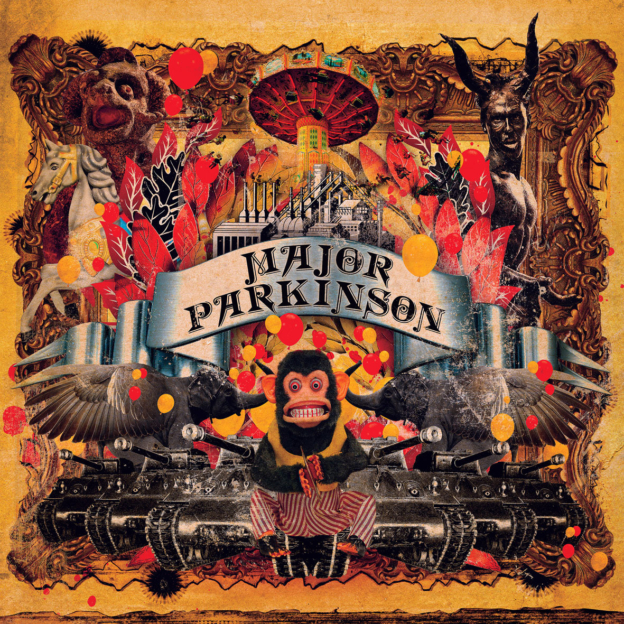
Review: Major Parkinson – Major Parkinson (2008)

I’m going to take this opportunity to start reviewing the first total curveball band I feel comfortable enough to review at this point in my review-writing “career” for two reasons: 1) I need to work on my writing chops for bands that I’ve only discovered within the last few years instead of half my life ago, and 2) I’ve listened to hundreds upon hundreds of bands and artists I’ve never listened to before between the end of college and now (2011 – 2017) and Major Parkinson is one of the only, if not perhaps the only, band that has hit the sweet spot in precisely the same way all those bands I started to love in my formative high school years did, so it’s a good one to start with.

I call Major Parkinson a “curveball band” because you’ve never fucking heard of them, and it’s unlikely that you’ll find a wealth of critical analyses, professional or amateur, or even written in English, about any of their albums on the internet (especially any as well-thought out and eloquent as mine will be, of course). So if you’re even mildly interested enough in these curveball bands that I’ll review from time to time that even my shitty opinions or painfully labyrinthine writing style aren’t sufficiently enough to deter you away now and forever, then please continue Gentle Reader and you will be unjustly not at all rewarded for any efforts on your part.

Major Parkinson is a band from Norway that has undergone many personnel changes since their formation in 2003, but at the time of their debut the lineup was Jon Ivar Kollbotn on vocals, André Lund and Alf Borge on guitar, Eivind Gammersvik on bass, Lars Christian Bjørknes on synthesizers, and Cato Olaisen on drums. The most accurate general description I have for Major Parkinson is “alternative rock”, but not in a Red Hot Chili Peppers or a Smashing Pumpkins way at all. Major Parkinson, like all underrated gems, defy easy classification, especially since they have tended to switch things up from album to album thus far. Think Tom Waits Swordfishtrombones-era vocals with a lot of jangly, abrasive ska-punk beats, old-timey carnival melodies, occasional other-worldly, atmospheric Porcupine Tree/Steven Wilson proggy and prog-metally gleanings, and even that doesn’t scratch the surface of their very distinct sound that culls from literally every musical style you can think of.

But forget what I just said for now, because Major Parkinson’s self-titled album debut lacks the vastness and diversity that would come later. It’s an album by a band very much still finding its footing, but while I would describe it as “stripped down” it’s incredible to my ears how much this band sounds unlike anyone else utilizing only the basic rock instrumentation. You can tell that each member of the band is thoroughly competent, almost exasperatingly so, with the way they can fluidly bend genres and weave in and out of complicated time signatures with grace. You know how certain prog and math rock can sometimes sound so jagged that transitions seem clumsy and uninspired? Almost as if that shit is completely unintentional but they’re playing off like it’s “just the way our challenging music is, dude, no way around it”. Major Parkinson has a knack for being able to phrase out four measures of music so adequately that you yourself, the listening audience, will end up subconsciously relieved that this is exactly the way those four measures went. I’m going to read this paragraph in the morning and see if it still makes a lick of goddamn sense.

Yep, sure does! No editing there! Anyway, the bottom line is that the merging of listenability with unabashed weirdness is impressive, because that’s not very easy to pull off (if intentional, of course. A band like Mr. Bungle would be offended to have their work mistaken as “listenable”). Major Parkinson is a record loaded with hooks and a focus on melody, of all things. What nerve, right? So many of these bands that try to put on the circus-punk vibe deliberately sacrifice anything that could be construed as catchy pop-sensibility in favor of deliberately inaccessible musical strangeness. Which I love, actually. Why am I complaining? Oh yeah, because deliberately inaccessible musical strangeness is fucking easy. Props to Major Parkinson for going the harder route.

OK, so Major Parkinson, the album, by Major Parkinson, the band, (italics!) isn’t as refined as later efforts, but let’s pretend that when this album came out in 2008 the later albums weren’t available yet. Let’s pretend really hard, ok? Now we have nothing to compare it to but itself! Fantastic!

NOTE: While the band is Norwegian, Kollbotn sings entirely in English, and they have a pretty good vocabulary and a moderate grasp on metaphors and idioms. That being said, the lyrics on the debut are atrocious and make no fucking sense. I’ll cull some examples from three musically top-notch tracks:

  • “Bicycle!” – “A radical sensation, my body is on the air/My face is pretty ugly, I see it everywhere/My mind is separated for better and for worse/It’s living in my stomach, I’m a lipstick in a purse“.
  • “Sanity Fair” – “But when did this obscene insanity become such a sophisticated topic to discuss for us?/When all that I wanted from the dirty Cinderella to uncover my expenses for the purple bus“.
  • “I Am Erica” – “I met a little girl on the marketplace/Born without a proper face/Made to fill that magical sensation/A lovely voice like a radio/Talking in a lavatory disarray/Jacuzzi conversation flow/It was the summer of 187“.

Three great songs with just shit turd lyrics that either show a fundamental misunderstanding of English or are obtuse-on-purpose for, I don’t know, art’s sake? Probably the latter, but being Norwegian isn’t helping them much in this case. I don’t even want to try analyzing the meaning of the songs, I doubt I’d get anywhere.

But that’s ok, since the music itself is so dang tasty that I’m not listening to the lyrics anyway. I mean, no kidding, I never paid attention to them until I started writing this review, that’s how little they matter. Things start off proper with the aforementioned “Bicycle!”, which begins innocuously enough with a cute, catchy, normal by most standards, fast-tempo major key lush surf rock introduction. On a dime, though, creepy punk-cabaret staccato minor key guitar takes over and sharply punctuates the eternity of dead air between each note. Now this makes it sound like things change vastly within the course of 20 seconds, but not really. Trust me. And if your average experimental/avant-garde metal band made this song it’s likely that the initial surf music wouldn’t get a reprise, but Major Parkinson understands the oh-so gratifying concept of the musical reprise and brings the surf back during the choruses.

Most of the other sounds follow this same thread of melodious offerings with satisfying musical callbacks. Other noteworthy songs include my personal favorite, the ultra-paranoid ska-from-Hell “It’s a Job”, which actually has an understandable narrative and clever lyrics about murder and what it takes to get away with it. Kollbotn really goes all in on this one, you can practically hear the guy sweating as he desperately pants through some of the verses. There are also cool watery guitar effects during the interludes! “Meat Me in the Disco” will stick in your head for days, and features some deranged female vocals that I can’t find a credit for unfortunately. “Casanova” is the closest the band comes to balladry, and it’s actually a very pretty little song. Even the vocals are toned down, but near the end Kollbotn can’t help but belt it out like a down-on-his-luck Cookie Monster. “I Am Erica” features flourishes of middle eastern sitar (real or synthesized, I’m not sure), which I think is nifty keen!

Some low points on the album aren’t low because they’re sub-par, per se, but low because a lot of the album is a bit same-y and these songs don’t particularly stand out. Among them, “Bazooka Mirror”, “Silicon Hips” and “197” are a tad interchangeable, but packed with hooks like any other Major Parkinson product that most bands would kill for. “Death in the Candystore” appears to be their hit from the album, but meh. Generic on the progression to my ears, and the energy is a little lackluster for the punk vibe the record is going for. And then by the time you get to the last two songs, “Awkward as a Drunk” and “Greatest Love”, don’t be too surprised if you’re quite tapped out by the style.

The sheer uniqueness and originality of the band bumps their debut a couple of notches for me, because when all is said and done, Major Parkinson is a nothing group of Norwegian nobodys who will never, ever break out into the mainstream. This should have really be a flash-in-the-pan freak event that everyone is alarmed by and forgets about a week later, and certainly nothing someone like me should have ever known about. But, as it stands, they kept on going, they made more albums, they got better over time, and Major Parkinson is a solid album that the band can look back on without the need for rose-tinted glasses. Most bands don’t have that luxury. Go ahead and give it a listen one day.

GOOD

Review: Primus – Frizzle Fry (1990)


Primus sucks! Guess what, the debut album from Primus isn\’t even their first album. They put out a live album in 1989 called Suck on This after only being a working band for about a month or two. I shit you not! I\’ve never heard Suck on This, but I\’ll need to talk about it anyway for some historical context so here I go:

Primus went through quite a bit of change during their early years, but eventually stabilized into the band of lovable fucks we know best consisting of bassist and vocalist Les Claypool, guitarist Larry LaLonde, and drummer Tim \”Herb\” Alexander. Tim\’s actual middle initial is W., so I don\’t know why he goes by \”Herb\”, but I approve of this nonetheless and you probably should too. This is a trio of accomplished musicians, having all been playing professionally or in cover bands for at least a little bit of time prior to Primus (most notably LaLonde, who was a guitarist for the possibly first ever death metal band Possessed). So when Claypool decided to round up his team, it didn\’t take long for the band to gel as a cohesive unit and put on a couple of kickass live shows. Claypool even borrowed money from his dad to cover the recording and the distribution of Suck on This (\”Special thanks to Pops for kickin\’ down the corn!\”)

I have no idea whether or not Suck on This effectively got the word out there or not, but less than a year later Primus recorded Frizzle Fry in the studio. Comprised of five brand new songs, five rehashed tracks from Suck on This, two little transition vignette-type tracks, and one reprise, Frizzle Fry is certainly a good starting point anyway and it\’s not necessary to start with Suck on This. Or even listen to it at all ever! Take it from me! So, obviously, I can\’t truly compare the two records to each other based on my own personal experiences, so I\’ll pretend Suck on This doesn\’t exist henceforward. Excellent.

The thing to know right away about Primus is that Les Claypool\’s bass is the star of the show, always and forever. Frizzle Fry is mixed as if the bass\’ volume is turned to 11, the drums accompany the bass, and LaLonde\’s six miles away playing guitar into a tin cup. And the bass is so obviously the forefront of each and every song that it\’s almost as if no considerations were taken into writing anything for the guitar and drum parts. For all I know, LaLonde and Alexander are completely improvising around Claypool\’s funky, mesmerizing basslines instead. Alexander\’s got this prog drumming style, with switching up constantly with flurries of flawless polyrhythmic syncopation, and LaLonde\’s guitar either dances swiftly around the tasty bass licks, or shreds out some distorted thrash metal riffs. Anyway you slice it, all three are constantly doing something interesting, and makes for some fun-ass music.

Claypool isn\’t the jaw-dropping virtuoso here that he\’d later become, or maybe he\’s downplaying it a bit on the groovy debut album (not that the bass parts aren\’t incredibly technical), but all the songs on Frizzle Fry have a pretty distinct identity dictated by the basslines. His immensely strange, high-pitched, goofy voice, which is the other Primus trademark, is established in full force for sure, and you\’ll probably either love it or hate it. And if you\’re the kind to hate it, you were going to hate Primus anyway.

SO LET\’S BEGIN: The album kicks off with a live snippet of the beginning of Rush\’s \”YYZ\”, which I believe is how Suck on This starts as well, but after a record-scratch type cutaway the real beginning of \”To Defy the Laws of Tradition\” revs up with an unassuming, not particularly in-your-face rumble of bass. …and then WHAM!, all of a sudden your face gets fucked with loud, slappy, funky bass! Woo! And listen to that guitar just twist and weave around it! Hotcha! And those drummy drums! Splooge! I keep talking about guitar and bass and drums like they\’re not on 99.5% of all albums in existence, but I\’m TRYING to DRIVE HOME the POINT that no one slouches in their role, and Frizzle Fry is a miasma of funky, punky, progressive alternative rock/metal with even a bit of jazzy shit thrown in for good measure. And while this stew of crisp funk punk swirls around you, Claypool weirds things up with his crazy voice and unsettling lyrics. In \”Groundhog\’s Day\”, for instance, he barely even sings. He just kind of meanders through some banal description of waking up and starting the day in a very oblique, Primus-like fashion. Same with \”Spegetti Western\”, which is just a rambling, hilarious narration of an unemployed stoner\’s Friday night. Some songs, though, oh man, some songs he really belts it out (\”TOO MANY PUUUUUUUUUUUPIES!\”).

Speaking of unsettling lyrics, do the lyrics truly mean anything? I personally don\’t think so. Primus aren\’t out for poetic revolution. The title track \”Frizzle Fry\” is a nice example: \”I don\’t believe in Santa Claus/I don\’t believe in spite/I have no use for beauty dolls/Especially on this night/I don\’t believe in miracles/I don\’t believe in lies/I don\’t believe in holograms/For I am the Frizzle Fry!\” What the fuck does all that mean? It\’s a perfectly good imitation of lyrical pomposity, perhaps, and even maybe satirizing it a bit. But I can tell none of this shit is from the heart. And why should it be? How about \”They Toys Go Winding Down\”: \”C.G. the Mexican is a friend of mine/We used to sit around the house watching Evil Dead/Talking about the way it used to be/Skit dat daddle dee dee\”. OK, so I pulled the least important-sounding verse in the whole song, but listen to it yourself. A lot of the verses sound pretty deep on the surface (\”One of the animals has left its cage today/In search of better things, so it seems to be/But in this land of polyurethane/Things are apt to get a bit hot as the toys go winding down\”), but then this is tempered by turned-on-a-dime outbursts such as \”It\’s pudding time!/It\’s pudding time!\” that make you go \”What the fuck, what\’s wrong with this guy?\”

Wait a minute, why am I wasting time trying to justify the lack of soulful meaning behind the words? That\’s not the point! Don\’t forget, this is supposed be fun, goddamnit! You won\’t find any real emotion here! Nevermind, I\’m wrong! \”John the Fisherman\” is a nice, little song that clearly comes from a sentimental place. It\’s the story of a young man who wants to grow up to be a fisherman, ends up being a fisherman, and it\’s implied that he dies doing what he loves. Claypool clearly identifies with John, and the fact that the next two albums also have a fishing song shows Claypool\’s passion for the sea.

What else is there? How about \”Harold of the Rocks\”, which is an incredibly catchy, less-than-veiled rocker about a crackhead of course, with my favorite line on the album \”He\’ll talk the balls off a rhinosaurus\”. \”Mr. Knowitall\” hits you with some ha ha ha IRONY at the end, but I won\’t spoil it for you except for right now: \”They call me Mr. Knowitall/I am so eloquent/Perfection is my middle name/And whatever rhymes with eloquent\”. Isn\’t that hilarious??!

And I almost forgot to mention the little interstitial \”Sathington Willoughby\”, which is fun little child\’s music box chunk-a-chunk-a dance beat that is over and out in less than half a minute, but it really PACKS A POLITICAL PUNCH, you might say. Essential? Hardly, but just try jumping straight from \”Pudding Time\” to \”Spegetti Western\”. Unnatural! The flow of the album is natural, don\’t take a single song out. They\’re all good!

I hate to compare Frizzle Fry to later albums at this juncture, because it\’s not like people had the luxury of comparing Frizzle Fry to later albums back in 1990, but general critical reception dictates that the first three Primus albums are the three best, with Frizzle Fry being regarded as the weakest of those particular three. Poppycock, I say; I love all these children equally. I think Frizzle Fry gets kicked around a tad because it\’s not as technically complex as Sailing the Seas of Cheese or Pork Soda. I don\’t like how this is seen as negative, since a lot of the riffs and solos on this record really fucking cook without the necessity of jaw-droppingly quick staccato passages and absolutely dizzying instrumental interplay that are all over the next two records. This is a milder Primus flavor, you know, but just as satisfying. Like, uh, Honey BBQ vs. Mango Habanero from Buffalo Wild Wings, I guess? I think that\’s a fitting simile considering that six out of Primus\’ eight studio albums have some sort of food or drink reference in its title. Didja ever think of that?

Primus certainly breaks some ground as far as alternative rock goes, with their unique marriage of punk, metal, funk, and everything else. Nothing has ever sounded like Primus and nothing has sounded like them since; they stand in their own echelon. However, I can\’t bring myself to call this one Very Good (and SPOILER ALERT, none of their albums may hit this pinnacle, I haven\’t decided yet) because I find it tough to avoid getting burned out on their particular style. Like a Buffalo Wild Wings chocolate cake, Primus\’ music is pretty rich and too much of a good thing can sour the broth. Or something.


GOOD

The First 10 Reviews

In only two months I was able to write ten fully fleshed out, not rushed, non-contrived (hopefully) reviews of actual music albums that actual musicians wrote and produced and distributed for the actual public. This is an extremely huge deal for me for exactly two reasons:

  1. I\’ve been wanting to write album reviews ever since I discovered George Starostin\’s website back in the summer of 2005 between high school and college, but I\’ve been deathly afraid to do so.
  2. I initially would have predicted that writing ten reviews would have taken me 30 times longer.

–Let me expound upon Point #1 for the moment. George Starostin is absolutely one of my biggest influences of all time, as far as people I don\’t know personally, when it comes to my interest in popular musical. I discovered his site back when the only real bands I listened to were They Might Be Giants, Talking Heads, Oingo Boingo, and I was just getting started dipping my toes into Frank Zappa\’s discography. Reviews of all four of these artists and bands were available on his website, and was bowled over at how intelligently Starostin\’s thoughts on all these albums actually were. It was as if he was involved in their production. It made me want to branch out to other bands in his \”Smart Pop\” category (in which TMBG, Talking Heads and Oingo Boingo resided). I wanted to intimately know all these bands as much as he seemed to. I wanted to be able to have my own intelligent thoughts about this music. But, and especially at the time, I knew nothing of the history of modern music whatsoever. Intelligently writing about music requires actual knowledge about music itself and its modern history, of which I still to this day have very little confidence about. I\’m getting better each day.

Starostin never claims to be musically trained. He even had his own hangups about starting a music review page back in the late \’90s. Hell, English isn\’t even his first language. The guy was born in Communist Russia. He has a degree in linguistics, though, which made me feel even less able to do what he does. Who the hell am I? I can barely tie my damn shoes, son, how can I describe the emotional, or lack thereof, nuances of Frank Zappa\’s Lumpy Gravy? But, above all else, Starostin pulls no punches when it comes to his brutally honest opinions. He also never pretends to be anything he\’s not, or to know more about something than he actually does, and I find that immensely respectable.

Also, part of my fear is that I feel like I need to know nearly everything about the band and its full history before even attempting to review their albums. This is why I\’m starting with the bands I\’ve loved since high school. I may love Nick Cave, but I\’ve only been listening to him for five years. I\’m terrified to write about him even though part of me knows that once I try I\’ll surprise myself. I may love David Bowie, but I\’ve only listened to about 12 out of his 25 studio albums so I\’m not qualified yet to make generalizations on his whole career. Don\’t even get me started on genres such as hip-hop or black metal, which are so new to me at the moment that it would be completely irresponsible of me to even attempt reviewing any such band or artist. How can I review Immortal or Bathory without any semblance of knowledge about why they sound the way they do at that moment in music history? How am I supposed to review Earl Sweatshirt without even a passing understanding of east coast vs. west coast hip-hop, or a complete sociopolitical understanding of the evolution of black culture with respect to and because of their music? I may enjoy it all, even immensely, but I\’m in no way ready to talk about any of it yet.

–Point #2 is more straightforward. I\’ve been writing on personal websites, personal blogs, and message boards in some capacity since my family hooked up the Internet in our house back in 2000, so for more than half my life I just want to write write write. The problem is that I can\’t think of any topics that hold my interest and drive me to actually write consistently lately. I mean, look at the rest of my sad, sorry little blog. I\’ve written one \”Goosebumps From Memory\” so far. That didn\’t last long, did it? \”Sucky Comics Sunday\” is my most popular feature, but I only made four of them and the last thing I want to do these days on a Sunday morning is scan for that very day\’s shitty comic strips and type up an entire thing. I won\’t even go into the \”RASP Files\”. Therefore, I figured I wouldn\’t be driven to actually write up album reviews as consistently as I have been so far. And that may still change someday, of course, but right now I\’m thrilled that I was able to get to ten in such a relatively short time. And, if anything else, I\’m more driven than ever to keep doing this.

Here\’s to another 10! Woo!

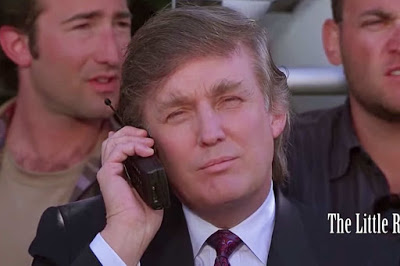
Because my OCD requires a picture in every post, here is a photo of Waldo\’s dad from the \’90s Little Rascals movie:

Review: Oingo Boingo – Nothing to Fear (1982)


Now we\’re talkin\’! Dial down the weirdness of Only a Lad a bit, make the herkys a little less jerky, add some mood, some real mood for chrissakes, but keep the fun and dancey and creepy completely intact, you\’ve got a monster of sophomore release. Not a literal monster. Don\’t worry, there\’s nothing to fear.

But man, it\’s hard to keep my subjective biases suppressed in this case. Nothing to Fear is an absolutely exhilarating record; ten songs with ten distinct personalities and not one clunker among them. Not one. No, I don\’t care what your opinion is at all. I\’m the one here with the sub-par and visually unpleasant blog with an equally sub-par music review section, not you, Todd. I don\’t care if you don\’t like \”Running on a Treadmill\” because Elfman \”sounds like a pussy\”, Todd. Cork it.

I\’m just impressed that Oingo Boingo was able to improve upon the already great Only a Lad without losing an iota of what made the band unique and enjoyable in the first place. The energy is still in full gear, the horn arrangements are mixed in seamlessly with the keyboards to maintain that ska-tinged new wave-y trademark sound, Elfman\’s voice is as frighteningly erratic as ever (even more so!), lyrics are loaded with sarcastic wit and sardonic vocal delivery, and every little nook and cranny of each song is packed to the gills with hooks.

But this is most certainly not Only a Lad Pt. 2, far from it. Nothing to Fear overall is noticeably heavier, with a more prominent use of guitar riffs and distortion. Tracks like \”Insects\” and \”Nothing to Fear (But Fear Itself)\” showcase some prime riffage you might expect from the heavy metal bands of yore, apparently even Black Sabbath-y at times to some ears (I personally don\’t make this connection). I also feel that the songs a little more organized and less aimless this time around, with more conventional song structure and fewer randomly located phrases with odd time signatures. Elfman broadens his emotional vocal range in a big way, adequately bouncing from frantic to wistful to paranoid to gleeful to gloomy and everything else, as the mood demands, and really showcases how talented and criminally underrated his singing really is, or was, as the case may be. Since the band\’s breakup in 1995, it\’s possibly that Elfman hasn\’t professionally sung a note since. His pipes might be all rusted and shit now, you know?

I suppose this album deserves a track-by-track in-depth analysis, if I\’m going to be so bold as to state that every song is good (go away, Todd):

  • \”Grey Matter\” is the opener, starting off with a few bars of contemplative, dreamy synth and then the driving bassline kicks in serving as the backbone to this somewhat confrontational anthem against groupthink and close-mindedness (\”They say you lost the ability to even think/That your tiny little brain slipped down the kitchen sink\”). The nice touch here are the rollicking xylophone passages that sound positively tribal, which is a cool contrast to the \”ultra-modern\” slick \’80s production.
  • \”Insects\” is fun, gritty tune very much in the spirit of Only a Lad\’s nervous, desperate energy. No real message here as far as I can tell, just a dumb, hilarious song, one of the best on this record (\”Just like little diamonds in the sky/Insects buzzing in my eye/Buzzing insects make me want to DANCE!\”)
  • \”Private Life\” might contend with \”Whole Day Off\” as the least memorable, but it\’s a very good claustrophobic and bitter Smiths-esque, or perhaps even Cure-esque, song about introversion and the paradoxical feelings of self-satisfaction, alienation, and social anxiety that comes along with it.
  • \”Wild Sex (In the Working Class)\” brings in an industrial edge with smatterings of clanging metal percussion. When you work a blue collar 9-to-5 job, banging around after work is the most exciting thing to look forward to! Fuck off, Bruce Springsteen, Oingo Boingo really connects with middle-class America.
  • \”Running on a Treadmill\” is the one that Todd hates (Todd isn\’t real, you guys, heh heh), but you probably won\’t! Straightforward metaphor about going nowhere in a relationship with catchy horns and clean, melodious singing from Elfman. Soulful! Emotional, and not even in an asshole ironic way!
  • \”Whole Day Off\” is the other contender for Most Forgettable on Nothing to Fear, as it\’s not very hooky by comparison to the other tracks around it, but don\’t dismiss it at all. It\’s a slow funk, swaggering lazy-on purpose tale of a guy who comes up with odder and odder excuses to stay home from work. Lyrics hint at the narrator unaware of his obvious mental disorder, but in a funny way! \”Have you seen my garden?/It is most peculiar/Have you seen my garden?/Nothing there that grows looks anything at all like plants/I hear their voices/Let\’s take the whole day off\” is one of my favorite Oingo Boingo verses of all time.
  • \”Nothing to Fear (But Fear Itself)\” is back to basics. Fantastic fucking song, with skin-crawling lyrics reminiscent of \”Little Girls\” or \”Nasty Habits\” from Only a Lad intended to make the listener feel uneasy (\”Hey little girl won\’t you come this way/Won\’t you let me buy you candy or perhaps a chocolate shake/Or perhaps some nice cocaine?/Or perhaps a little kiss?/Or perhaps a ride in my big car?/Perhaps a ride in my big car?/Won\’t you make an old man happy?/Won\’t you make an old man happy?/Won\’t you let me show you paradise?/Don\’t ask your mother for advice/There\’s nothing to fear but fear itself\”). Perhaps the best hook on the whole record comes after the sped-up tempo chorus, where it slows down back to normal speed and Elfman ominously reports \”The temperature is starting to drop\” completely with an echo on \”to drop\” that continuously lowers in pitch. These Boingo bitches are smart cookies, aren\’t they?
  • \”Why\’d We Come\” is NOT about those \”You\’re NOT The Father!\” episodes of the Maury Povich White Trash Festival of Tears, but rather about the evolution of mankind and how we\’re not any further along in modern society than we were in the stone ages! Duh! Good use of Eastern scales on this one. Best part: the ultra sarcastic delivery of \”We\’re civilized/Isn\’t that nice?!\”.
  • \”Islands\” is the most stylistically different song in the bunch. Moody and monotone, almost like Joy Division in its hopelessness and despair without the tortured, suicide-committing frontman of the band angle. Again, the theme is isolation and loneliness, but, as a contrast to \”Private Life\”, \”Islands\” feels suffocatingly agorophobic in its sprawl. Absolutely haunting in its message and vocal delivery. Underrated as all fuck.
  • \”Reptiles and Samurai\” ends the album on an upbeat, yet bewildering, note. Another good use of Eastern scales, bringing in the ancient Japanese vibe, the song purports to show the difference between reptiles and samurai, of course, tongue-and-cheekly (tonguely-and-cheek?). People have tried to make interpretations on real meaning behind this one, but I think the more you read into it the dumber things get. Just enjoy it for what it is, a catchy, stupid song about reptiles and samurai.

There you have it, a laboriously compiled in-depth analysis of an album nobody wants to hear. But you should hear it, because it\’s Very Good. And in a year when Toto\’s \”Africa\” was topping the charts, Nothing to Fear was probably a much-needed breath of fresh air for the disturbed minority. And no, I don\’t even like Toto\’s \”Africa\” ironically like I\’m supposed to.

VERY GOOD