Review: Frank Zappa – Uncle Meat (1969)


To this day I have no idea what \”Uncle Meat\” actually means. I remember being very upset in my pre-Zappa obsession days about this title, associating the juxtaposition of two dissimilar words as \”random\” humor (I went to high school in the early \’00s where using the \”purple monkey cheese\”-type string of unrelated words as a \”joke\”, or something, was a huge hit among pasty anime nerds, Invader Zim fans, and other like individuals in the bottomless basket of deplorables). I\’m not as upset with the name anymore, because I don\’t hold grudges like that fucker Daniel from 4th Grade that I\’m still mad at (who was shorter than me at the time, by the way), because I later realized it might just be a deliberate nonsense word combination, meant to be \”ugly on the ears\”, signifying nothing. Nevertheless, \”Uncle Meat\” as an inscrutable phrase shan\’t preclude one from the enjoyment of Uncle Meat as an album of musical notes and words. Don\’t be a petulant Grade-A Dingus.

The first double album since the debut Freak Out!, this was an ambitious project designed to coincide with an even more ambitious Uncle Meat film project. The movie never got finished, but in 1987 some documentary footage was released. I don\’t really want to dwell on the movie aspects of the Uncle Meat concept because the CD reissue contains 45 minutes of movie documentary excerpts that are just about the most frustratingly inessential Zappa material in existence (included as three tracks shoved onto Disc 2 before the King Kong suite). I don\’t remember much of it as it\’s been about 12 years and I only listened to these tracks once, but the only thing I do remember is a woman (groupie?) describing her encounters with the Mothers of Invention, sexual and otherwise. The dialogue is circuitous, uninteresting, and dumb. \”Interminable\” is too nice of a word to describe the listening experience. One phrase from the excerpts has been burned in my brain, though: \”he used a chicken to measure it\”. I\’m sure you could crack the code of what this phrase refers to out of context, but they never explicitly explain what this means in context or why it was repeated (*does a quick check*) 34 goddamn times throughout the 45 minute duration. Therefore, I\’m making an executive decision in this review to not consider this shit for my final subjective rating. This stuff wasn\’t included in the original Uncle Meat album, I see no reason to bring an album down a bunch of points because of some bonus tracks tacked on 20 years later. The album is too good to let this ruin it.

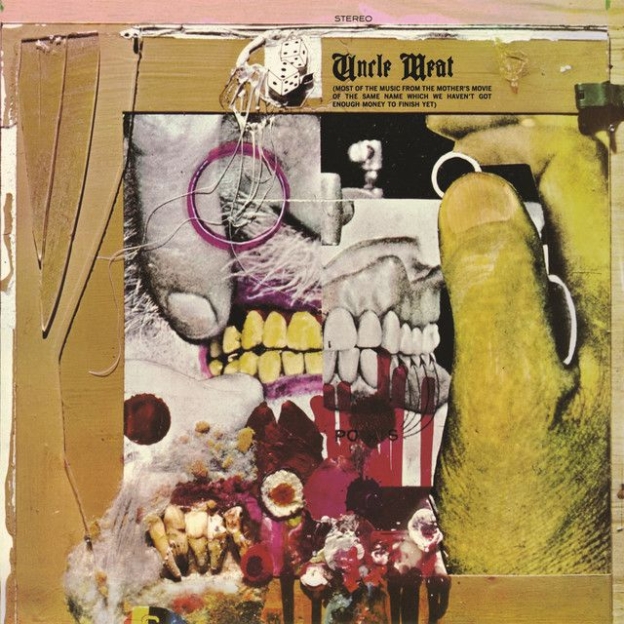
SO LET\’S MOVE ON. The ugly-ass cover art collage does a good job of preparing you for what to expect. Uncle Meat is a veritable smorgasbord of musical ideas, a nice hodge-podge of exquisite harmonious musings, a real humble jumble of elegant smatterings and (*checks thesaurus*) odic (*squints*) contemplations? It begins with 22 relatively short tracks, zipping and pinging past, stuffed to brim with all manner of style: free jazz, classical, acoustic jamming, electric jamming, percussion soloing, doo-wop, non-free jazz, avant-garde, rock, blues, spoken word. This is followed by a 7-part 18-minute free-form jazz fusion excursion known as \”King Kong\”, which was a huge concert staple at the time that didn\’t see much light in the official discography\’s future releases until the posthumous albums and bootlegs were issued. It all comes together in a nice, meaty package. HA!

So what to make of this avuncular meat? Worth noting, this album marks a large departure from past efforts. Except for Lumpy Gravy, which is stylistically similar, the rest of the catalog up to this point focuses on social commentary undercut with bluesy or catchy pop-sensible melodies. Now, there are barely any tracks that actually have lyrics or spoken word elements, and the social commentary is nearly entirely absent (I say \”nearly\”, because who knows if something is meant to be commentary or not. The dude wrote another song about vegetables). A lot of the music is also more technically challenging and experimental, with Zappa playing around a lot more with sampling and tape manipulation. Allegedly, and funnily enough, this conscious shift in musical vision lost a lot of fans at the time in 1969, even though the essence of Uncle Meat itself pretty much represents the archetypal Zappa sound that people think of when they think of Zappa\’s music. Liberal use of crazy polyrhythms, odd time signatures, pockets of frenetic staccato passages that are over and out within a measure or two, plinky mallet percussion, squealing saxophone, all present on Uncle Meat in spades. The only element missing is the more-than-occasional sprawling guitar jam, which still hasn\’t wormed its way into regular familiarity yet by this point Zappa\’s discography. Save it for Hot Rats.

With many varying styles comes the possibility of jarring lack of cohesion, but there\’s nothing here that\’s so off-the-wall that it sticks out like a sore thumb. Which is odd, because you\’d think a fanciful flute-y orchestral \”Legend of the Golden Arches\” followed by a rough recording of Zappa introducing Don Preston playing Louie Louie on the Albert Hall Pipe Organ followed by an assertive orchestral \”Dog Breath Variations\” followed by the soft-rock lullaby \”Sleeping in a Jar\” (\”The jar is under the bed!\”) followed by a clip of good ol\’ Suzy Creamcheese (first appearance on Freak Out!) talking followed by another plinky instrumental \”The Uncle Meat Variations\”, and so on, would suck! But it doesn\’t! Everything melds together nicely like a warm Carl Weathers stew. And everything is so short that, hey, even if you don\’t like it that much it\’s not sticking around for too long. WITH THREE EXCEPTIONS, and you\’re a petulant Grade-A Dingus if you don\’t like any of this stuff either:

  • \”Nine Types of Industrial Pollution\” is a 6-minute pretty little acoustic guitar jam that definitely doesn\’t overstay its welcome, especially since the track is actually sped up from a normal-speed 10-minute recording (OH WAIT, THERE IS A GUITAR SOLO ON THIS RECORD. Scratch out what I said at the end of that one paragraph up there, this album does have everything!).
  • \”Ian Underwood Whips It Out (Live On Stage in Copenhagen)\” begins with a narrative from Underwood himself describing his initial interest in the Mothers and first contact with Frank, then jumps to 4+ minute total saxophone freak out that\’s delicious on the ears!
  • \”King Kong\”, ya turkey. I\’ve already mentioned this.
I think what really brings everything together is the fact that you can tell Frank is having fun making the music he wants to make. It was at about this point in his career that he truly felt like he owed it to his audience to challenge them, to make them work toward appreciating something that would be rewarding if they stuck to it. He didn\’t always succeed. and he really missed the mark occasionally, almost heading in the opposite direction at times (*coughFloAndEddiecough*), but it\’s impossible to say that he didn\’t succeed with Uncle Meat. It\’s a testament of how seriously Frank took his work, even if the music itself doesn\’t sound serious at all, and one of the prime examples in his catalog of an album that seems silly on the surface and profound in depth. Just don\’t dwell on its shitty name, you petulant Grade-A Dingus.
VERY GOOD

Review: Oingo Boingo – Only a Lad (1981)


If you took a survey on the street and got a good sample size of ordinary, average Western civilization-type human beings of a reasonable age (let\’s say 20+ years), you\’ll likely find out that people are more likely, possibly a great deal more, to recognize the name of Oingo Boingo\’s frontman over the name of the band itself. And huge fans of Oingo Boingo would find this perfectly reasonable. How many other bands share this trait? You got your Kurt Cobains and your Ozzy Osbournes, who may be recognizable names to people who couldn\’t name but everyone has heard of Nirvana and Black Sabbath. Maybe someone like Rod Stewart (the Faces) is good example, but the guy from Oingo Boingo even has the distinction of not moving on to be a successful solo artist. No, I think this is a pretty unique case.

The frontman, of course, is Danny Elfman, known for the soundtracks and scores to numerous major motion pictures such as the two Pee-Wee Herman movies, the first two Tobey Maguire Spider-Man movies, nearly everything Tim Burton ever did, and a whole wealth of other endeavors. He composed \”The Simpsons\” theme. You may even know the horror music he scored for \”when Donald Trump stood behind Hillary Clinton during the second 2016 president debate\” which was a meme everyone forgot after 20 minutes. Anyway, the point being that you wouldn\’t know him from fuckin\’ who-cares Oingo Boingo even though it was the greatest achievement of his career. Whatever.

Anyway, Oingo Boingo. Yeah. The whole thing started as a musical theater project of Danny\’s brother Richard Elfman in 1972, and back then they called themselves The Mystic Knights of the Oingo Boingo. Richard eventually passed the torch to Danny, who continued the fanciful cabaret traditions and slowly transformed the troupe into the rock band it would become by the \’80s. During this whole time they were almost completely unknown outside of the Los Angeles scene, and eventually got their big break when an early version of their \”Only a Lad\” song from their 1980 self-titled EP got a lot of airplay on the local radio.

I find this progression into modest success rather interesting. Go ahead and try to draw comparisons to other early new wave acts such as Devo, or Wall of Voodoo, or XTC, or whatever, but Oingo Boingo came into their own slowly and organically and formed a truly unique miasma of post-punk, ska, pop, and most importantly, cabaret. \”Importantly\”, because cabaret was far from cool in the punk scene and nobody else wanted to touch it with a ten foot pole. At least on the early Oingo Boingo albums, you sometimes get a creepy circus vibe that really really works. And Danny\’s voice is perfect for this marriage of styles, just a manic rubber bouncy ball of alternating highs and lows of both pitch and intensity.

Which brings us to their debut album Only a Lad. A fully fleshed out piece of work, this album is. The band\’s personnel here is made up of eight musicians, scaling back from 400 or however many made up the original Mystic Knights of the Oingo Boingo. Guitars, bass, drums, keyboards, saxes, trumpets, trombones, it\’s like the fucking Blood, Sweat & Tears lineup, only good music is played instead!

But, man, how to describe what you\’re hearing when you drop the needle in the ol\’ groove? \”Little Girls\” begins the album with a cheesy, self-aware sarcastic horn fanfare as if welcoming in Pope Alzheimers XIV and then the disjointed, angular, punky new-wavey real intro kicks in, and then it\’s a bunch of pedophile-friendly lyrics sung by a pedophile-friendly voice! What gives! This shit is so catchy, but the subject matter is so unsavory! Why is Danny Elfman doing this to me? With lyrics like \”I-I-I love little girls/They make me feel so good/I love little girls/They make me feel so bad\” how am I supposed to admit to enjoying this godless song to the other women in my knitting circle?

OK, at least the in-your-face deliberate discomfort of \”Little Girls\” is the most shame you\’ll feel within the next 40 minutes. The next track, \”Perfect System\”, is a nervous-energy cartoonish advertisement of communism where Elfman sounds like he\’s singing its praises with a gun to his head (\”In a perfect system/There\’s no confrontation/Unnecessary friction/To impede our concentration/We\’ve simply done away with /Unnecessary friction\”). You can hear his clenched teeth as he spits out the verses, and while the lyrics look quite David Byrne-esque in print, Elfman really pumps the words chock-full of ambiguities in implication and connotation with his rubberband voice every chance he gets. \”Capitalism\” is an equally nervous-energy cartoonish adverisement of capitalism where Elfman sounds annoyed that he has to sing its praises at all, even. Here again, lyrics say one thing (\”There\’s nothing wrong with Capitalism/There\’s nothing wrong with free enterprise/Don\’t try to make me feel guilty/I\’m so tired of hearing you cry\”), but the vocals sneer through every line. At a casual glance, the tone and message of these two songs appear to be conservative but you don\’t really know where Elfman stands on any of this. While he may not agree with his own message, while he may be playing a character, he still isn\’t afraid to leave listeners hanging to make their own interpretations.

Take the title track \”Only a Lad\” as another example. A tale of a shitty kid with psychopathic, violent tendencies, this time the satire appears to be taking a shot at the liberal viewpoint (\”Only a lad/You really can\’t blame him/Only a lad/Society made him\” and \”Perhaps if we\’re nice, he\’ll go away\”), and in it he includes a line with delivery that betrays his true feelings (\”Hey there Johnny boy/I hope you fry!\”). This suggests that perhaps Elfman isn\’t dyed-in-the-wool on either side of the political spectrum, and perhaps presents these messages this way as an encouragement for his listeners to be free-thinkers themselves? Could be?

But don\’t let me get in the way of your enjoyment of Only a Lad with boring, pseudo-political, mostly incorrect analysis! There\’s a lot of other fun to be had here! If your brain is broken like mine, you\’ll find this album\’s version of \”You Really Got Me\” a vast improvement over the Kinks\’ original, and I won\’t do it justice describing it here. \”Controller\” ramps the paranoia up to 11 with high-energy lyricism that, I believe, describes the fear of someone coming by to steal away creativity (\”There\’s someone knockin\’ on my door/There\’s someone knockin\’ on my door/I think they\’re looking for me/I think they\’re looking for me/Pretend there ain\’t nobody home /Don\’t make a sound, don\’t even move/Don\’t give them nothing to see/I think they\’re looking for me\”).\”Nasty Habits\”, the album\’s closer, may very well be the best song on the record as Oingo Boingo returns to its roots with a full-on ska-tinged circus nightmare, and leaves you creeped out all over again.

SOME SONGS I COULD DO WITHOUT, HOWEVER. \”What You See\” is so unremarkable and plodding that it will make you forget the number 7 (WHICH IS THE TRACK NUMBER, YOU SEE). \”Imposter\” is ok enough, but sandwiched between \”Controller\” and \”Nasty Habits\” it gets lost a bit by the surrounding greatness. \”On the Outside\” is actually a good song; it doesn\’t belong in this paragraph, but you might forget about it anyway since it has the most straightforward beat of any other song on the album EXCEPT maybe boring\’ ol \”What You See\”.

OTHER CRITICISMS: Man, I don\’t know. I hate to pull the \”lack of diversity\” card, because I don\’t sincerely believe it\’s an issue, but there\’s a \”samey\” quality throughout that I can\’t put my finger on. Each track has its own distinct oddball personality for sure, but it\’s all the same flavor of oddball. Everything is herky-jerky to the nines, so all this angularity isn\’t tempered at all by, I don\’t know, mood I guess. The album\’s tone is plateaued for its entire duration. Again, not a bad thing at all, but if I have to compare Oingo Boingo to Oingo Boingo and nobody else, then this is a quality they improve upon in the next two albums and it is my duty to dock five invisible space points on Only a Lad for this reason.

LISTEN TO: This immensely enjoyable album.
DO NOT LISTEN TO: My dumb ass for only calling it \”Good\” like some charlatan.


GOOD

Review: Frank Zappa – Cruising with Ruben & the Jets (1968)

What a piece of shit collection of songs. Let\’s get this one over with. No burying the lede here!

Remember in my review for Lumpy Gravy that you undoubtedly read where I talked about Frank Zappa strokin\’ his limp little dick over contemporary classical music? Well that\’s not all he strokes his dick to! He\’s got enough gas left in that pud for some doo-wop music as well, the kind your Alzheimer\’s-addled grandmother used to listen to. Aha, so that\’s where Frank\’s fixation with dramatic, high school teenager concerns and preoccupations in his lyrical subject matter comes from! He loved this stuff as a kid and, naturally, maintained his deeply-rooted nostalgia over it. Imagine Frank Zappa, admitting nostalgic feelings! HA HA HA HA HA HA HA!! OMG!

The idea to make Cruising with Ruben & the Jets came about from the Mothers of Invention sitting around during a recording session waxing nostalgic about their high school days and their shared love of doo-wop. Why one would have fond memories of high school at all is beyond me, but these nerds all agreed that doo-wop was the proverbial bomb. It was decided to record an album of such tunes as an homage to the bygone days of gender roles and dropping non-proverbial bombs. Of course, by 1968 doo-wop wasn\’t cool at anymore by any young person\’s standards, so it\’s lost on me who exactly this album is for. Anyone with similar nostalgia for doo-wop isn\’t going to listen to brand new doo-wop music.

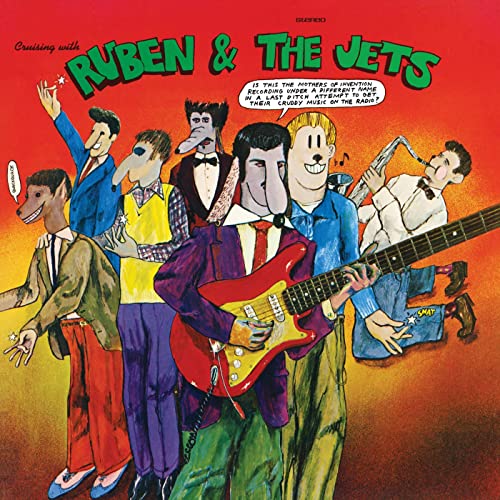
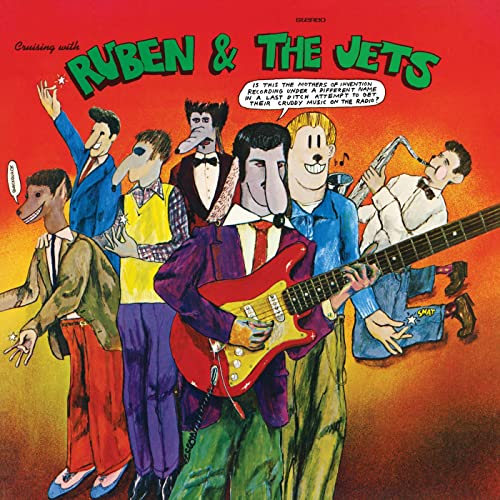
The Mothers fabricated a backstory to accompany the album. Ruben Sano, depicted on the back cover as a photo of a high-school-aged Frank Zappa, was the leader of a band called the Jets. There was this whole thing that was going to tie into the Uncle Meat storyline with Ruben & the Jets slowly turning into anthropomorphic cartoon dog-like animals, and IT\’S A SHAME IT NEVER REALLY PANNED OUT, but the by-product of this concept was that some of these songs got a lot of airtime due to the misunderstanding that this was actual, lost-to-the-ages authentic doo-wop music from the \’50s by a real goddamned band called Ruben & the Jets and not the lumpy, smelly men of the Mothers of Invention. The front cover even has the disclaimer \”Is this the Mothers of Invention recording under a different name in a last ditch attempt to get their cruddy music on the radio?\” Zappa claims the effect was actually unintentional, but it\’s funny nonetheless.

So yes, Cruising with Ruben & the Jets is an immensely radio-friendly album, and without a doubt the most \”accessible\” in Zappa\’s catalogue, at least in terms of musical complexity. My extremely meager knowledge and experience with doo-wop music limits my ability to speak intelligently about it (HASN\’T STOPPED ME IN THE PAST, THOUGH! OH SNAP!), but to my ears there\’s a noticeable diversity of styles and moods ranging from, uh, happy to sad, I guess.

Let\’s start with the upbeat rockers (doo-woppers?). To my uninitiated, doo-wop-hatin\’ ass, these songs are actually pretty fun. In this category you got \”Cheap Thrills\” (a lovely yarn about backseat car fuckin\’), \”Jelly Roll Gum Drop\” (a wonderful tale about a young man fancying a comely lass), and \”No. No. No.\” (a beautiful ditty about a young man fancying a comely lass). All three are guarantee to burrow in your head and leave you singing \”NO NO NO NO NO NO NO NOOOOOO BOP DOO-AY-DOO BOP DOO-AY-DOO\” to your cat for days. I would consider these the best three songs on the album, because if I\’m going to get a bunch of simple dumbshit lyrics I\’d rather not have it sound like I\’m expected to take it seriously.

Then there are the optimistic, yet mellow, schmaltzy lovey-dovey songs. I\’d lump \”Love of My Life\”, \”Deseri\”, \”Anything\”, and \”Fountain of Love\” in this category. With lyrics like \”Stars in the sky, they never lie/Tell me you need me, don\’t say goodbye\” or \”Do you remember I held you so near/Our love\’s glowing ember so precious and dear\” it\’s hard to fucking believe Frank Zappa is playing this straight (OR IS HE?!). But yeah, honestly, any Zappa fan is going praise the hell out of these songs while at the same time steering clear of any non-Zappa music that even skims the doo-wop genre, satirically or not. And with such sincere subject matter and lack of musical/lyrical dissonance, this stuff certainly doesn\’t do it for me.

Next are the sullen, pessimistic, yet still mellow, jaded songs of love lost. In this category we have \”How Could I Be Such a Fool?\”, \”I\’m Not Satisfied\”, \”Later That Night\”, \”You Didn\’t Try To Call Me\”, and \”Anyway the Wind Blows\”. Surprise! If you\’re paying attention, you would have noticed right away that four out of five of these are reworked versions of songs that originally appeared on Freak Out! And successfully reworked, to boot! And why not, considering all you really had to do was take away the sneer that prevailed the older versions. The music compliments the lyrics nicely this time around, not that there\’s anything bad at all about the Freak Out! versions either. This is the first official example of Frank molding and manipulating his existing work to fit his needs, and he spent his whole career continuously reworking old songs. I like these songs on the record better than the above lovey-dovey ones, because I\’m about as lovey-dovey as a PENIS in a BUTTHOLE.

I saved the real best song for last, as in, realer bestier than the other three that I said were the best earlier: the closer \”Stuff Up the Cracks\”. It\’s unlike the other songs, in that it has an unfittingly cheesy yet morbid-for-this-album line that throws you for a bit of a loop (\”Stuff up the cracks/Turn on the gas/I\’m gonna take my life/Stuff it!\”) and it builds to a more straightforward blues number at the end where FRANK ACTUALLY PICKS UP HIS FUCKING GUITAR AND SHREDS FOR A COUPLE OF MINUTES. JESUS HOPPING CHRIST, MAN, WHAT A RELIEF.

Here comes the ultimate question to this day about this strange, strange happenstance of an album: was this all just an elaborate Ween-style joke that was played so straight that no one can tell for sure, or was this an honest-to-God faithful tribute to a bygone era of music?

  • OK, let\’s entertain the idea that it\’s the former scenario. Frank Zappa is a sarcastic asshole, likely incapable of true sincerity, and most of his career was predicated on satire, parody, and cynicism. But what we do know is that he took his work very seriously, so what better joke than to spend the time and effort to meticulously and methodically craft an album of songs that are so by-the-book that his stupid audience and all the stupid radio DJs won\’t be able to tell that he\’s just tricking them. Good way to make money and get your name out there, right?
  • Well, maybe it\’s the latter scenario then. \”Hey, Tom, you don\’t have to make me feel like a loser, you know, the way you wrote the first bullet point and all.\” Shut it, I\’m not saying that entirely. Hell, if this was truly a loyal, from the heart homage to doo-wop music, then why is this the only instance in funny-boy Frank Zappa\’s entire catalog of a presumably humorless, and a decidedly mindless, collection of songs? What\’s the point?

This is why I believe the two scenarios aren\’t mutually exclusive. Zappa truly, truly loves this music (or else he wouldn\’t waste his time), and he thought it would be inherently funny to play it straight for a whole record (and don\’t forget that he made up a strange, cartoonish backstory as a concept to compliment the album). Best of both worlds, right? I think he pulled it off well.

But, in the end, this isn\’t a groundbreaking piece of art, just fluff. And once you know the whole history and psychology behind Cruising with Ruben & the Jets, it\’s hard not to write it off as a complete novelty. I don\’t go back to this one that often at all, and I can\’t say that I\’m compelled to seek more of this kind of music from genuine doo-wop groups. It is, however, an incredibly competent effort from a band who wanted to make their version of the music they grew up with. Just don\’t expect it to change your sad life.

JUST OK

Review: Talking Heads – More Songs About Buildings and Food (1978)


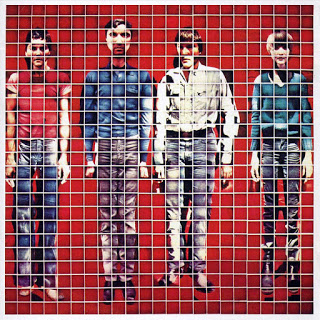
Check out these nerds getting cheeky with album titles already on their sophomore effort. Let\’s call attention straight away to the opinion some people have that we\’re dry and boring, that way we beat those critics at their own game! Actually, the real story is that they couldn\’t come up with a title, so they made fun of the fact that they weren\’t able to come up with a title by coming up with that title. I think the cover art is really cool, and certainly a 180° flip on the level of effort involved compared with the minimalism of the debut album art. 529 Polaroid snapshots, which means somebody luckier than me had to get right up nice and close to David Byrne\’s crotch. Imagine standing still that whole time while a photographer took each photo. That\’s some OK Go music video level of tedium right there.

I\’ve been thinking a lot in the last week or so about how I truly feel about this album. For sure, Talking Heads are very diverse between albums, but inter-album diversity leaves a lot to be desired. More Songs… is their jangly, rhythm-heavy guitar record. There is a lot of repetitive interplay between Byrne and Harrison while Weymouth keeps it steady with her funky bass on most of these 11 songs, and even after multiple listens everything seems coalesced into one big slab of angular, jagged, anxious guitar. Melody and mood both take a backseat, so the audio color palette is incredibly narrow.

Sit down with a group of Talking Heads fans to discuss More Songs… and I\’d imagine each person\’s two personal favorite tracks won\’t overlap drastically. For me, the standouts are the opener \”Thank You For Sending Me an Angel\” for its sheer optimistic driving rhythm, and \”Found a Job\” with its offbeat lyrics and energetic, hypnotic jam at the end. As a whole, the album is a grower, but after 12 years of listening to it I can\’t say that I find it as charming as do most people I see lauding it on review sites and message boards. It also doesn\’t help that the next two albums are significantly, significant, significantly better, but I digress.

Lyrically, this album is chock full of quirky, early-Heads non-poetic poetry that doesn\’t depart from the first album\’s aesthetic whatsoever. The aforementioned \”Found a Job\”, a song that I believe is about a married couple who uses their mutual hatred of TV to strengthen their failing relationship, jarringly starts with one of my favorite Talking Heads lines of all time, \”DAMN! That! Television!/What a bad picture!\”. The slightly obnoxious \”The Girls Want to Be with the Girls\” is another Battle of the Sexes pep talk therapy session that\’s awfully reminiscent of Talking Heads: 77\’s \”Tentative Decisions\”, and just as obtuse. \”The Good Thing\” has no pretense of romanticism with it\’s ultra-cold (and hilarious) corporate business jargon of a chorus to describe intangible concepts (\”As the heart finds the good thing, the feeling is multiplied/Add the will to the strength and it equals conviction/As we economize, efficiency is multiplied/To the extent I am determined the result is the good thing\”). It\’s all Byrne being Byrne, as we are coming to find out, and whether everything makes sense to the audience is not his fucking problem as far as he\’s concerned! But you do have to admit that, for a band with a lot of criticisms of pomposity, you can\’t really listen to these lyrics and cry \”pretentious!\”. Save that for the super-serious, overwrought garbage that your average progressive metal band will try to pass off as meaningful lyrical soul-bearing. This is just fun shit, mang.

While I can, at worst, tolerate each and every song on Talking Heads: 77, I find all the closing tunes on More Songs.. starting from \”I\’m Not in Love\” to be a real goddamn slog. I think by the time I finish out \”Artists Only\” I\’ve already felt like I\’ve gotten the gist. \”I\’m Not in Love\” and \”Stay Hungry\” are disposable, relatively low-energy robo-Asperger\’s \”love songs\” that I don\’t think work very well here in early-Heads territory with the overall mood. \”Take Me to the River\” is a cover of Al Green\’s song. I\’ve never heard the original before, but the positive thing I can say about this Talking Heads version is that it doesn\’t sound like the rest of the album. Other than that it has never really done anything for me. \”The Big Country\” is the longest song here, kind of a droning cool-down after the onslaught of the rest of the record, and probably the first genuinely emotionally resonating attempt by the band thus far. I do have a hard time with this one, because on one hand the somber melody and the lyrics about disillusionment about the Great American Way of Life kind of pluck the emotional strings in a gentle, enjoyable, yet odd way, and on the other hand…the song just kind of keeps going and going. Plus, I think they tackled this subject better with \”(Nothing But) Flowers\” on their final album Naked.

Moving past my own personal hangups with More Songs…, this record is considered a gem of the new wave scene. A lot of the credit goes to the slick production of one Mr. Brian Eno, whose talents combined with Byrne\’s are a match made in heaven. BUT, while More Songs… certainly feels fuller and less sparse and isolated compared with Talking Heads: 77, Eno is a guy well-known for enhancing moods, or even creating moods that the instruments alone aren\’t fully conveying, and I think he falters a bit here. I don\’t get an Eno vibe from More Songs…, and I\’ve heard my fair share of Eno-fied albums. SEE, even when I start a paragraph with ambitions to move past my own personal hangups I have to ruin it by whining.

Fuck it, maybe on a really good day this album has what it takes to get the semen shooting out the ol\’ dick (pardon the common Victorian-era expression), but I\’ve been incredibly lukewarm about it forever and I\’m not going to bump up my opinion because of everyone else. You\’ll probably love it, though, knowing you and your milquetoast bourgeois banality. Fie!


JUST OK

Review: Frank Zappa – Lumpy Gravy (1968)

OK, now is probably a good time to discuss Frank Zappa\’s major musical influences considering that this is his first true-blue \”solo\” effort. Most famously, he was a huge fan of both Russian 20th-century composer Igor Stravinsky and French 20th-century avant-garde composer Edgar Varèse. Slightly less famously, he also enjoyed the works of Anton Webern and Béla Bartók. Even less famously, he enjoyed much other modern classical music, but I don\’t have the time and patience to sift through hundreds of Zappa interviews in a quest to hear or read him namedrop some obscure composers. The point is, without any kind of classical training to guide his ear at an early age he gravitated toward this so-called \”serious\” music. And he listened to it recreationally too, like some highfalutin\’ little pretentious piece of shit. So write off Zappa all you want as a novelty act, but rest assured that the bulk of his young artistic influence and much of his methods are rooted deeply in classical. The guy even wrote most, if not all, of his songs in manuscript form. He fancied himself a composer, and by all accounts…why the hell not, right?

Zappa was also big into doo-wop and blues, but it\’s more apt to discuss that on the next review for Cruising with Ruben & the Jets anyway, wouldn\’t you say? Glad we agree!

Lumpy Gravy as an album is intended to compliment We\’re Only in It for the Money as part two of a three-part concept. For me this thread of continuity is very loose, and it doesn\’t hinder the experience in any way if one were to spend his entire life listening to these two albums without that knowledge. There are some musical ideas that are similar, and maybe a couple of themes overlap (such as law enforcement), and one song in two different arrangements shows up in both, but in general these two albums are starkly different. While We\’re Only… is more rock oriented, Lumpy Gravy is more orchestral in structure. Sort of. There are rock elements there too. And spoken-word elements. And jazz elements. It\’s kind of a mess, really.

There\’s actually a whole history to this album that would be rather laborious to get too detailed about here. In a nutshell, Zappa was commissioned by Capitol Records, which wasn\’t his label at the time, to create an album of orchestra music as a composer. He was not contractually allowed to perform on the album himself, so he rounded up a team of session musicians to play his music. These session musicians were kind of assholes about it; they didn\’t take Zappa seriously because he was a scruffy young counter-culture hooligan. They wrote off Zappa all they wanted as a novelty act, just like I accused you, the reader, of doing in the very first paragraph! But, differences were set aside, they realized that Zappa was serious, and everyone became friends! At least that\’s what the Wikipedia article says. The original releasing of the album was pulled shortly after due to some lawsuit scuffle between Captiol and Verve, which was Zappa\’s actual label at the time. While it was pulled, Zappa reworked some of the album, and the final product was released finally in 1968.

A lot of ado for 32 minutes worth of material. The album is broken up into two roughly-16 minute chunks, aptly titled \”Lumpy Gravy Part I\” and \”Lumpy Gravy Part II\” with some sub-section titles. I\’d say there\’s a little more music on Part I compared with Part II, which seems to have more spoken-word bits, but there are no major thematic differences between the two sides. The album as a whole is essentially a hodge-podge collage of musical ideas, concepts, and some vague social commentary. There\’s not much flow to the production, one needs to just go along with the ride.

Let\’s start with the actual music. The orchestra that Zappa wrangled together is made up of nearly 50 individual musicians, which is insane to me considering the recordings sound sparse and high-school-marching-band-esque. Not that it\’s a bad thing, the music bits are honestly absolutely delightful. A lot of this music will show up in other incarnations in many future albums over the course of Zappa\’s career, such as \”Oh No\” (Weasels Ripped My Flesh / Roxy & Elsewhere) and \”King Kong\” (Uncle Meat). Some of the more classical orchestral snippets can be heard in 200 Motels. Frank always fleshed out his musical ideas in real time, and rarely does something ever go away forever. If Lumpy Gravy were the last Zappa album you ever listened to, you\’d be pleasantly surprised at how much of this stuff from this early on sounds very familiar and, thus, memorable. The bad part is, once you start getting into the groove of one melody, you may suddenly get whisked away to a brand new section. But it\’s nice while it lasts. Music gets an A+.

Unfortunately, the actual musical portions of the album makes up about half the time. The other half is made up of monologues and conversations from Frank\’s buddies. Again, there\’s a lot of background detail on some of this that isn\’t worth getting into here, but most of the dialogue is part of the \”piano people\” concept Frank cooked up, which involves recording people talking into an open grand piano and allowing the voices resonate on the piano strings and cause vibrations. Zappa would throw out topics (which are incredibly abstract) and the dialogue would be completely improvised. More expanded dialogue would make up the loose-story backbone of the Civilization Phaze III album, which is part three of the three-part concept! Since it\’s album #70 or so, I\’ll get around to reviewing it in 2051 during Robot-Trump\’s presidency, and there would be the best place to really dig into this dialogue. For now, though, all you need to know is that the piano people live in dark isolation and are obsessed with pigs and ponies, which I believe are allusions to police and hippies. It\’s really dumb, the people talking sound really dumb. This shit gets a D-.

I personally very much enjoy this album in spite of the unreasonably harsh previous paragraph, but I\’d be hard-pressed to admit that I\’ve listened to it more than a dozen times in my life. I can\’t imagine that anyone listens to it recreationally on a regular basis, either, but it serves as a nice little piece of Zappa history that you can throw on from time to time when you\’re in the mood. For this reason, I hesitate to give it anything more (or less) than a middle-of-the-road rating. No one should make this their first Zappa purchase, but no one should make it their last either. Enjoy the music, tolerate the dialog, and wait a year or two before giving it another spin.


JUST OK